
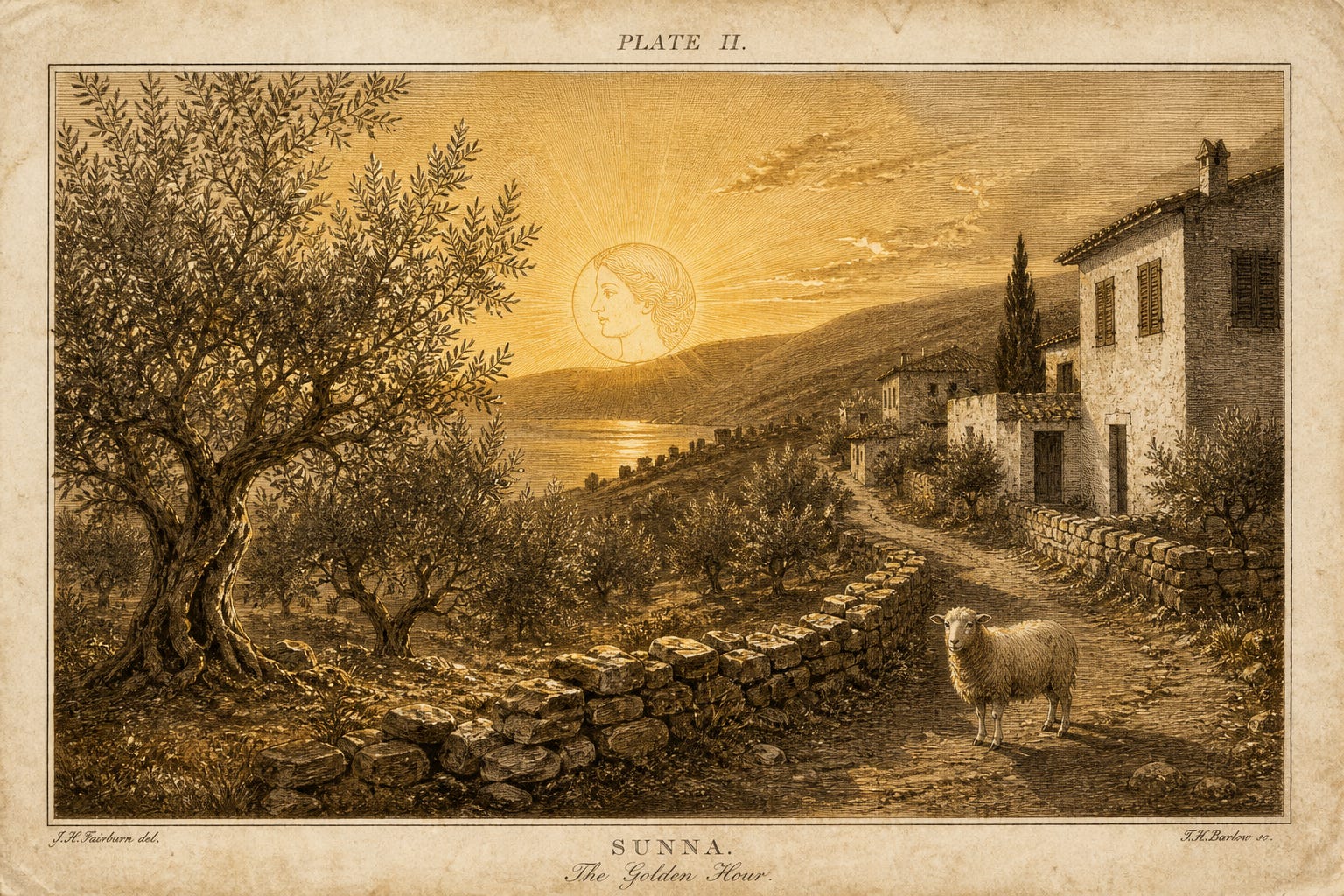
Che bella estate! (What a nice summer). I bet the tourists here in Sardinia noticed how, on this island especially, light has texture.
Anyone who has painted, photographed, or simply stood still long enough near the Mediterranean knows what I mean. Morning light arrives pale and sharp, picking every stone out of a wall as though the mason finished it five minutes ago and is waiting nearby for compliments. At noon, the entire island is placed beneath a forensic lamp. Every hill is flattened, every shadow interrogated, the granite turns white, the roads shimmer, and even the sheep look personally offended, and everyone is smart enough to make sure all their window shutters are closed (houses are dark inside, in the summer).
Then, toward evening, our star finally puts away the flamethrower. The light slides sideways across the land, catches the silver undersides of the olive leaves, turns dust into gold, softens the mountains, and gives every ordinary object a more flattering, almost magical new life.
The golden hour… my favorite time of day. It’s when you say goodnight to Sunna, the Sun, and she goes down behind the hills like a Roman diva who knows perfectly well the audience is still watching.
I once wrote her a piece of music, years ago… a classical composition for four violins and chamber orchestra. This year it was reborn with a voice. If you want a soundtrack while you read about light, it is here: Sunna, Unveiling. My tribute to our life-giving star, a goddess, the way I see it.
Ma torniamo in sella… (let’s get back in the saddle).
We were speaking of light.
I have spent decades manipulating light as an artist and freelance illustrator… drawing it, painting it, faking it. Chiaroscuro. Reflection. Refraction. Translucency. Warm light against cool shadow. The blue that creeps into skin when the sun is behind it. The hard white edge on a glass bottle. The tiny reflected gleam that tells your brain a painted eye is wet and alive.
One dot of white paint in the correct place and suddenly the dead pigment is looking back at you. That is light for an illustrator… not decoration, but the key of the craft.
I know how to make a cheek turn toward a window that doesn’t exist. I know how to make polished metal look cold and old wood look warm. I know that violet belongs inside shadows people insist are grey, and that skin is never “flesh-colored,” whatever fresh hell the crayon manufacturers were thinking.
I know light the way a luthier knows wood… not primarily through equations, but through the hands. I taught myself oil painting at eighteen and spent the first several professional years pushing real light around in linseed oil and turpentine… glazes, translucency, the slow layered way the old masters built a glow (Caravaggio being my favorite). The twenty years after that, to meet deadlines, I had to use faked light in digital painting software instead (unfortunately). For myself, to this day, I still draw in pencil… graphite being nothing but light and its absence, negotiated in grey.
And yet nobody ever told me what the damn thing actually is.
Pensaci. Think about this for a second.
Everything you have ever seen, you saw with light… and you have never seen light itself.
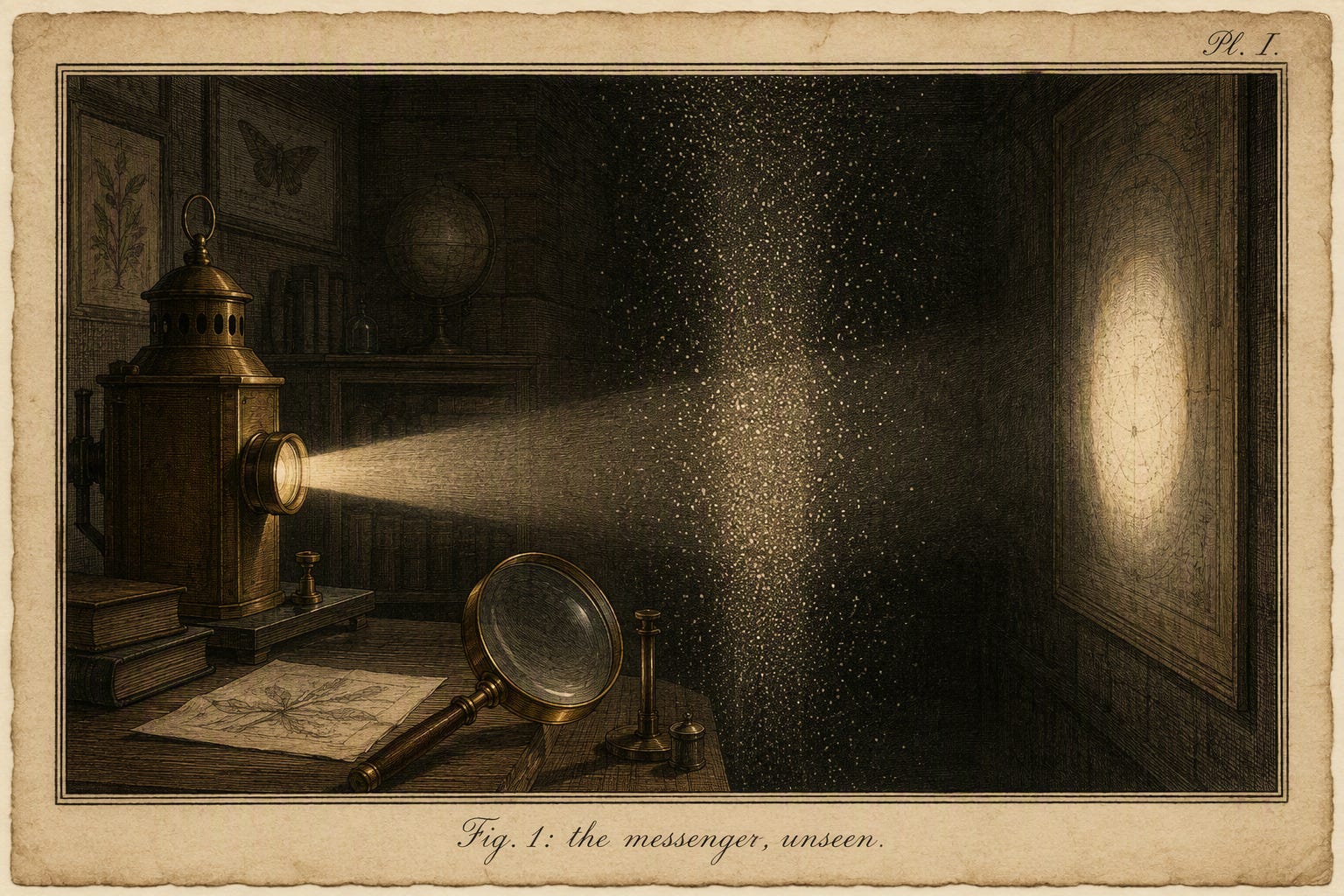
A beam crossing a perfectly clean room is invisible. Shine a torch through empty air and nothing appears between the bulb and the wall. Add smoke, mist, or dust, and suddenly the beam materializes… but what you are seeing is not the light. You are seeing the things it struck.
The sunbeam in a cathedral is made visible by dust. The lighthouse beam is made visible by fog. The projector beam in an old cinema is made visible by whatever has been floating above the seats since 1974… dust, dandruff, ghost particles, the fossilized breath of a thousand people who watched Jaws.
Not the light.
The messenger itself never shows its face. You see only the fingerprints it leaves on matter. Your entire visual life is secondhand testimony about something nobody has ever looked at directly.
Your eyes are not witnesses… they are taking witness statements.
So what is the messenger?
Ask modern physics, and you receive one of its most famous drawer-label answers:
It is a particle. It is also a wave. It behaves like whichever one the experiment requires. Do not attempt to picture it too literally.
Ma grazie. Very helpful.
I’ve spent thirty years painting with a substance whose official police description is: sometimes a bullet, sometimes a ripple, known to change appearance depending on who is asking, approach with mathematics.
At some point, the illustrator in me puts down the brush, turns the canvas around, and says:
No. Show me the construction lines.
The Sound of the Sea
Start with something we are all familiar with.
A sound wave is not a tiny object called “sound” flying through the air toward your ear. Nothing resembling a miniature opera singer launches from Pavarotti’s mouth and crosses the theater with its arms outstretched.
The air itself moves. One region compresses the next, which compresses the next, which compresses the next. The molecules mostly jiggle around their own positions like commuters being shoved along a crowded Metro platform.
What travels is the pattern.
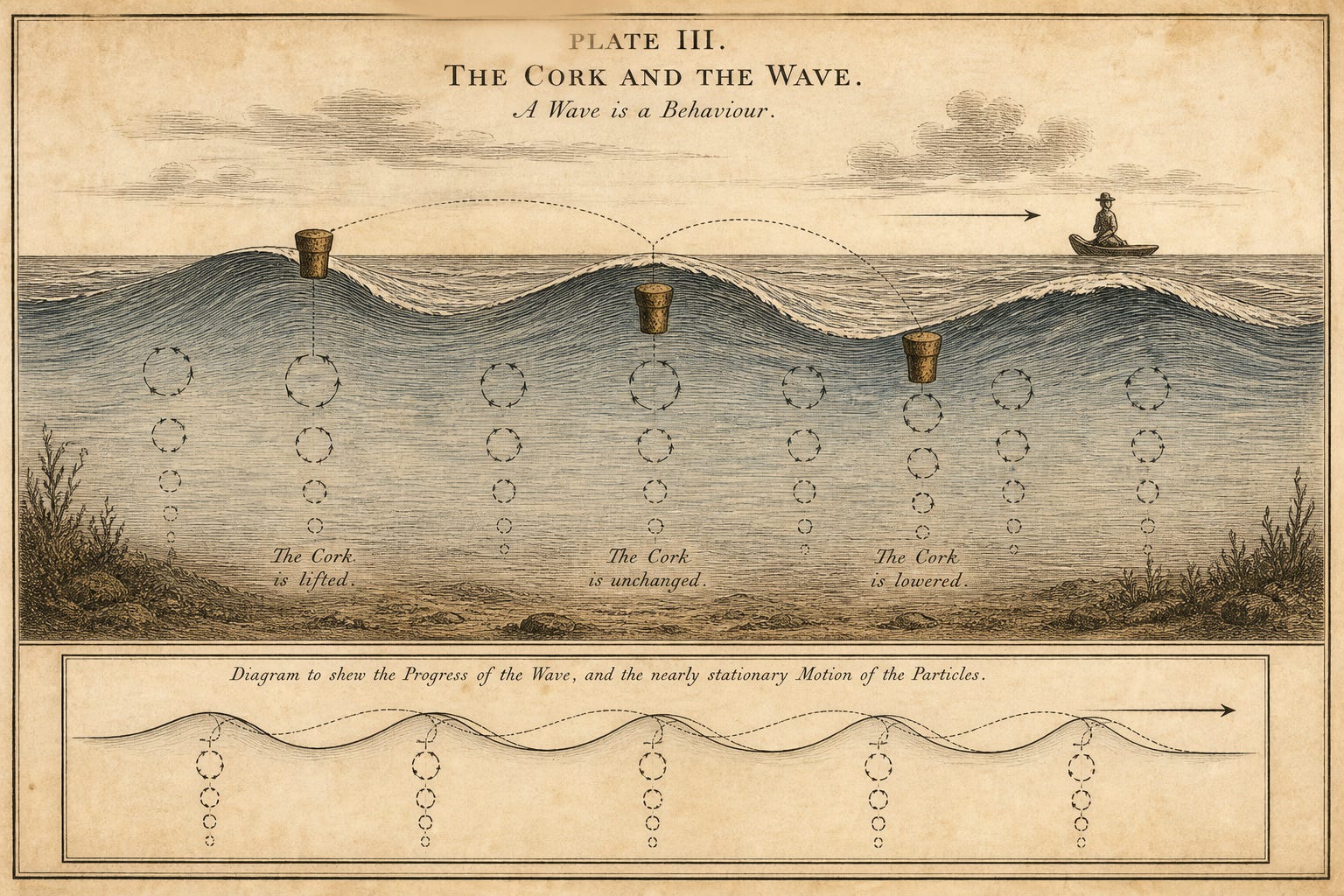
The same thing happens on the sea. Watch a cork bobbing beyond the shore. A wave approaches from fifty meters away, lifts the cork, lowers it, and continues. The cork does not ride all the way to the beach, leap onto a towel, and order a spritz. The water mostly circles and bobs in place while the shape passes through it.
Every surfer understands this in the bones. The wave arrives… the water was already there.
A wave is not an object. A wave is a behavior… more precisely, it is the behavior of something.
Sound is air behaving. An ocean wave is water behaving. An earthquake is rock behaving very badly. A vibration in a violin string is the string behaving musically. A Mexican wave in a football stadium is thousands of people behaving like idiots in a highly coordinated manner.
The people do not run around the stadium… the pattern does.
Every single wave human beings had ever encountered was the state of a medium. Every ripple had a pond. Every tremor had something doing the trembling.
Then came light… and physics eventually decided that this was the one wave in the entire universe that waves in absolutely nothing.
Hold that thought. Notice how weird it is before familiarity applies the anesthetic.
An electromagnetic wave has direction, frequency, wavelength, amplitude, phase, polarization, interference, diffraction, standing-wave patterns and resonances. It turns corners, overlaps itself, cancels itself, makes fringes, forms harmonics… it plays the entire repertoire of the wave family: counterpoint against itself, canon with its own echo, standing chords held between two mirrors. As a composer, I love writing for strings… so, I know a section player when I hear one. Light sits first chair in the wave section of the universe, sight-reading from a score published in 1864.
But ask what is waving, and the answer is:
The field.
What is the field? The thing that is waving. Duh!
Ah… siamo tornati al carrello. We are back at the shopping cart.
Mass resists because it has mass. The field waves because it is a field. They like to make us walk in circles, don’t they?
Another definition wearing a lab coat. We have met this fellow before… I am getting tired of seeing him everywhere…
Maxwell’s Forbidden Sentence
Here is where the history becomes almost too perfect.
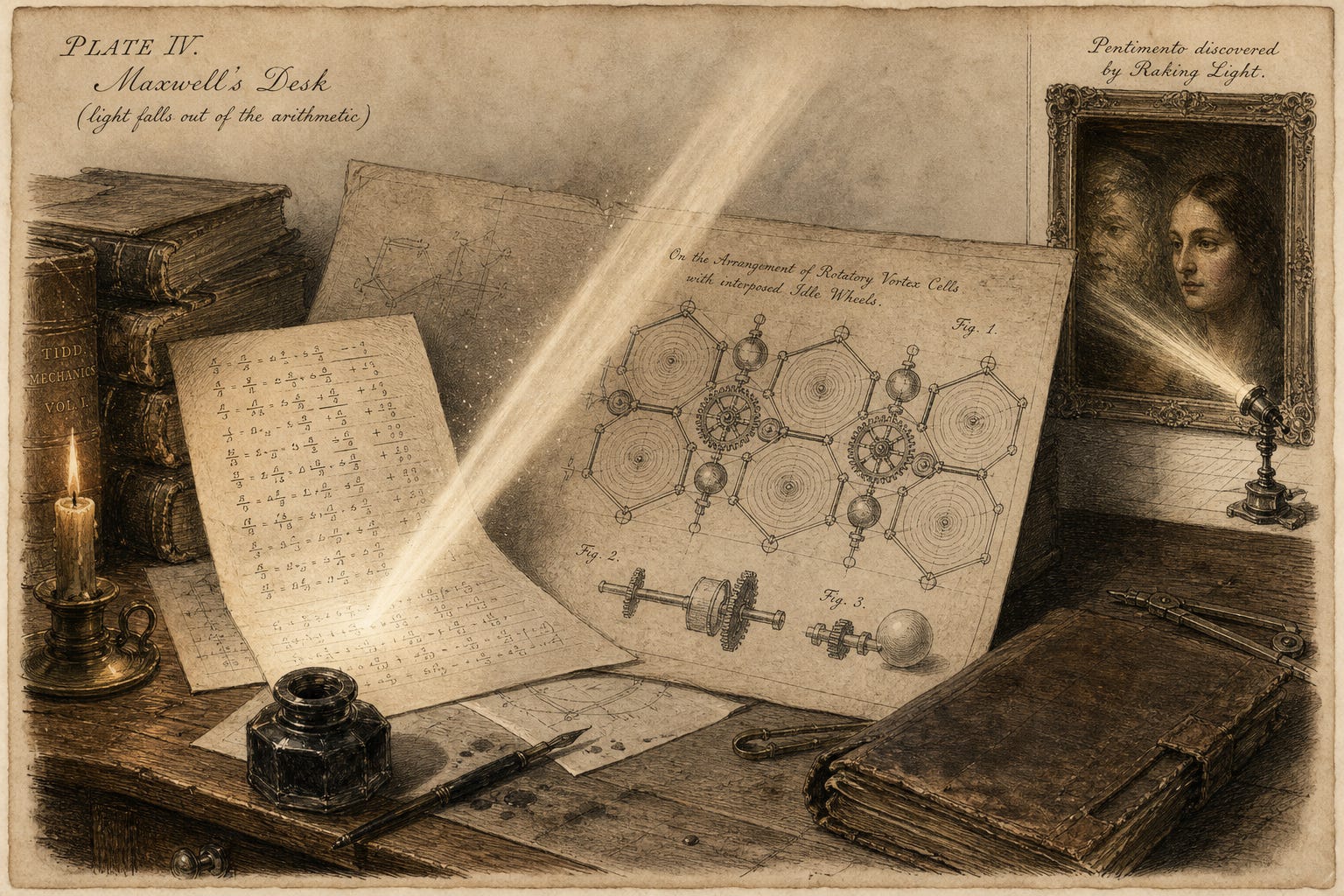
In the 1860s, James Clerk Maxwell was working on electricity and magnetism using the mechanical picture we met in the first essay… tiny intermediate wheels and elastic stresses in a medium filling space.
Yes… the gears.
I know.
Physics becomes very embarrassed whenever you mention the gears, like you have produced photographs from its experimental phase at university. But the gears were there.
Maxwell was trying to understand electromagnetism as the behavior of something physical. He did not begin with immaculate equations descending from heaven on stone tablets. He built a mechanical architecture, pushed it, twisted it, and asked what mathematics fell out.
And from that physical model, Maxwell assembled the equations that now bear his name.
Those equations did something phenomenal… they predicted waves.
Not metaphorical waves. Not “wave-like mathematical behavior” accompanied by interpretive jazz hands. Actual propagating disturbances, with a definite speed that could be calculated from two electrical quantities already measured in tabletop experiments: the electric permittivity and magnetic permeability of empty space.
Maxwell put the numbers in.
The speed came out equal to the measured speed of light.
Fermi tutti! (Stop everything!).
Imagine being Maxwell at that desk. You’re doing calculations about electricity and magnetism, probably expecting another useful relation involving wires and coils, and suddenly light falls out of the arithmetic.
Light had been hiding inside two electrical constants the way a pentimento hides inside an old painting… an earlier image sleeping beneath the visible layers, sitting there for years while everyone admired the surface, until someone finally examined the canvas in raking light and found another face looking back.
Electricity, magnetism, light… three phenomena that had appeared unrelated collapsed into one structure on a sheet of paper. It was one of the great moments in the history of human thought.
And Maxwell wrote down the obvious physical inference:
“We can scarcely avoid the inference that light consists in the transverse undulations of the same medium which is the cause of electric and magnetic phenomena.”
Read that again.
The man whose equations unified electricity, magnetism and light said that light consists of transverse undulations of a medium.
Not particles mysteriously impersonating waves. Not equations propagating through ontological silence. Not a probability cloud traveling through a mathematical shrug.
Undulations… of a medium.
The author of the equations left us the construction sketch. Physics kept the finished canvas, cut the sketch from the back of the frame, and marked the original design documentation:
LEGACY COMMENT. DO NOT IMPLEMENT.
The program compiled, so nobody reopened the architecture. The physical model was deprecated. The calculation survived… the thing being calculated was quietly deleted.
Boh! Once again, I find this a very strange thing to be relaxed about.
What Light Actually Is
So let us keep Maxwell’s sentence alive for five minutes and see what it buys us.
Same working hypothesis as the previous essays… no new zoology, no additional force, no extra machinery.
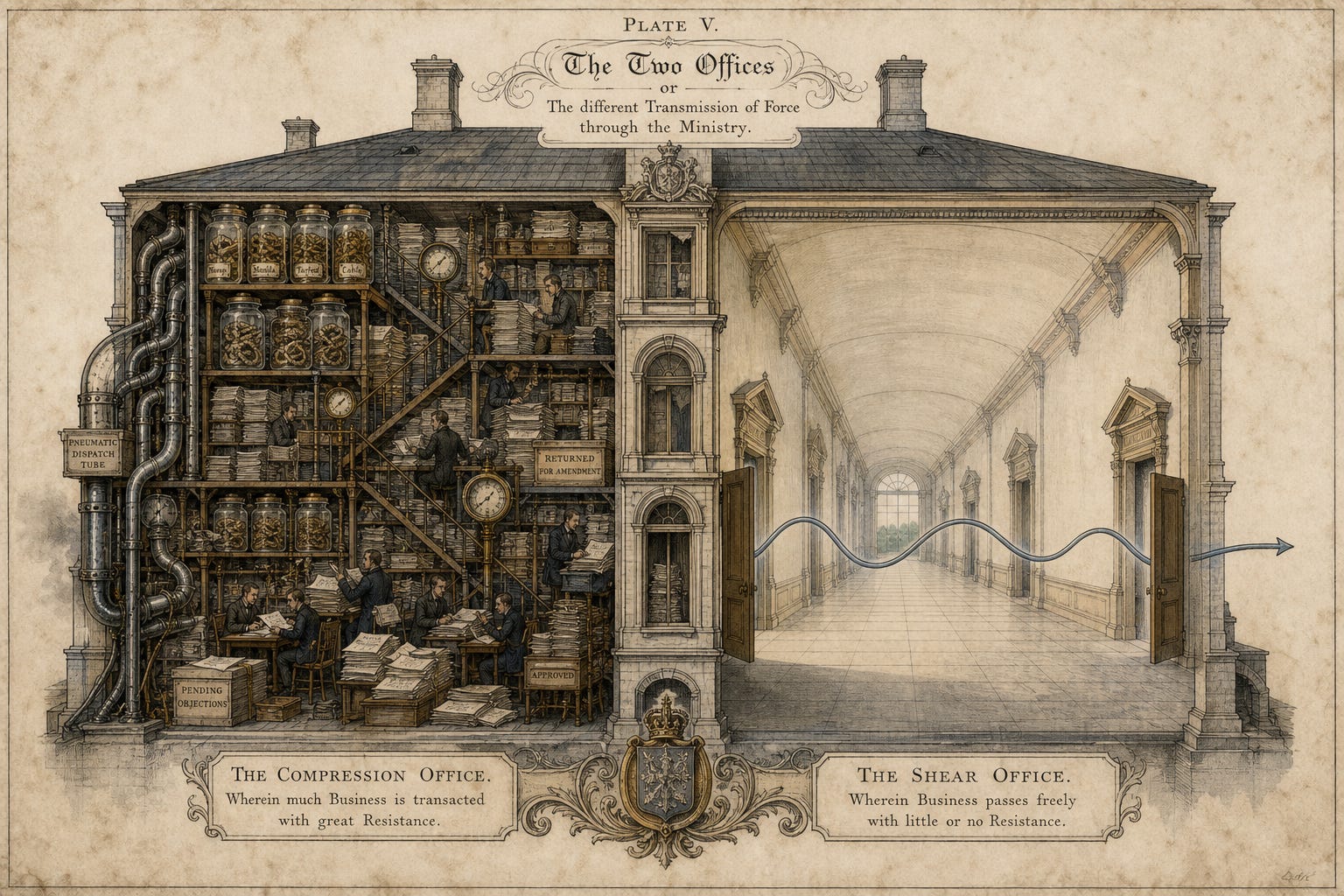
Suppose space is not an empty container. Suppose it is a physical substance with two distinct ways of carrying stress… two ledgers, as we called them before:
A compressional ledger, governing squeezing, density & pressure… and a shear ledger, governing sideways displacement, twisting and transverse motion.
Two offices in the same cosmic bureaucracy. The Compression Office handles knots, pressure gradients, mass and the heavy paperwork. The Shear Office handles light. No appointment necessary.
Then light is simply the medium doing something in the shear ledger.
It is not an object moving through space… it is a behavior of space.
The sea itself, waving sideways.
And the moment you say that, several of light’s supposedly mysterious properties stop being separate mysteries. They become geometry… not “solved” with another dictionary definition, not assigned to four different particles, twelve symmetries and an emergency committee.
Geometry.
Why is light transverse?
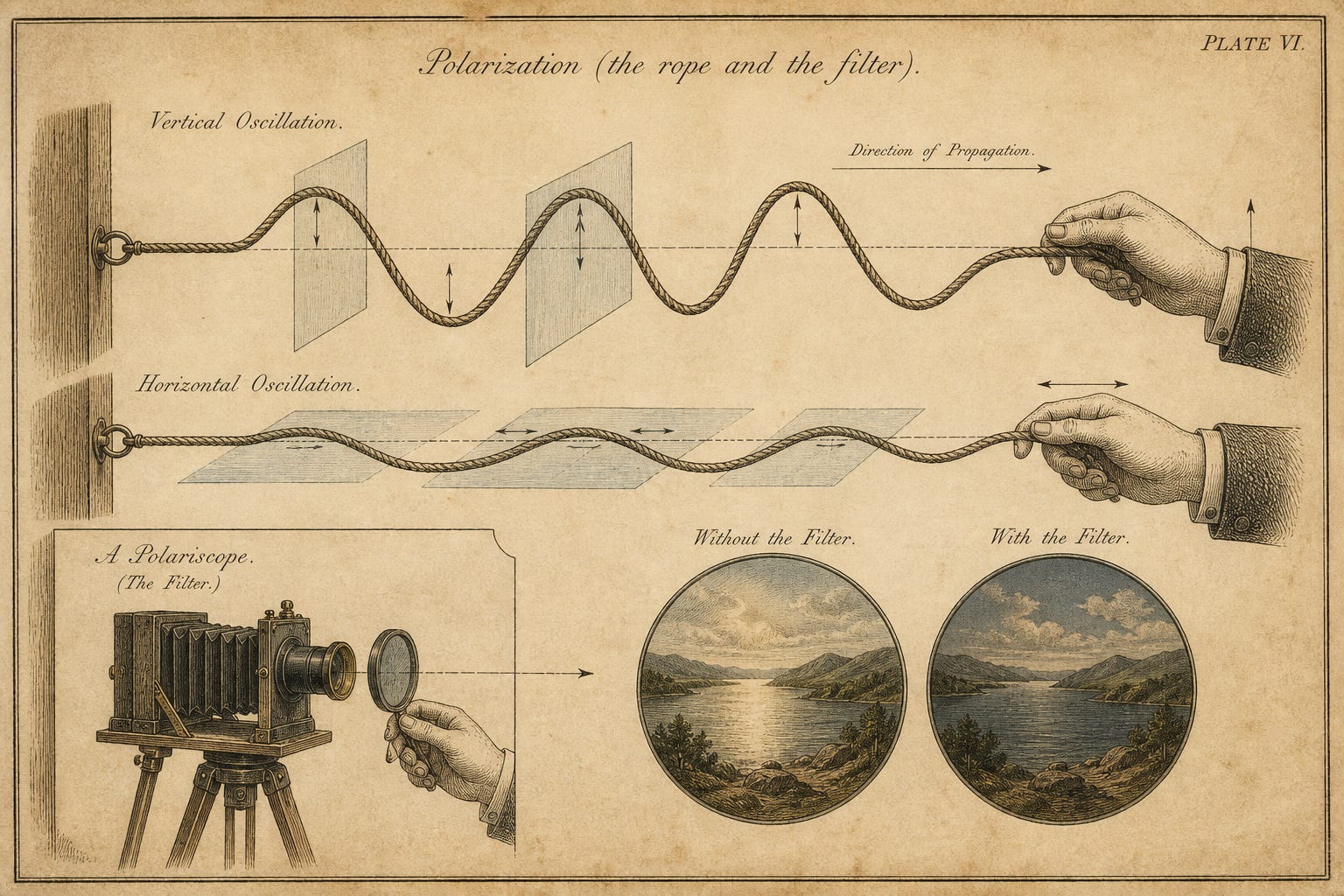
A transverse wave is one in which the medium moves sideways relative to the direction the wave travels. Shake one end of a rope up and down. The wave travels horizontally while the rope moves vertically. The motion of the medium is across the direction of propagation.
Light does the same thing. Its electric and magnetic components oscillate perpendicular to the direction in which the wave travels.
Why?
Because light is a shear wave… and that is what shear waves are.
No extra rule. No little foreman standing beside each beam shouting, “Sideways, ragazzi! We discussed this!”
Light is transverse because it belongs to the transverse sector. Asking why a shear wave moves sideways is like asking why scissors cut with two blades.
That is not a later behavior added to the object… that is what the object is… capito? (get it?)
Why does light have exactly two polarizations?
I became familiar with polarization using photography filters, which I used back in the 1990s, when cameras contained actual film and every photograph cost money.
Yes, children… you took the picture and then waited several days to discover that someone had blinked. It was a barbaric age. Barbaric!
Put a polarizing filter on a camera, rotate it, and the glare on water changes. Reflections vanish. The blue sky darkens. Glass becomes transparent. The world reveals that light has orientation.
But why are there exactly two independent orientations?
Because we live in three spatial dimensions.
Take a wave moving forward. One direction is already occupied by its travel. That leaves exactly two independent directions perpendicular to it… up-down and left-right, or any rotated combination of the two.
Two sideways directions… two polarizations.
Not because the universe assembled a quantum committee, circulated a consultation paper and voted seven to four in favor of two. Because three minus one equals two.
The quantum mystery is suddenly basic spatial bookkeeping. A fact about light collapses into a fact about the room.
Why is light massless?
Because light is not a separate object being carried by the medium… it is the medium’s own propagation.
A wave can carry energy and momentum. It can push a solar sail, heat your skin, knock electrons loose and burn a hole through metal. A Mexican wave can knock over your beer if the person beside you becomes overenthusiastic.
But there is no separate object called “the Mexican wave” running around the stadium. The pattern is real. It has effects. But it is not a passenger.
There is no little solid item inside a beam whose rest mass must be transported from the bulb to the wall. There is no rest frame in which you can pull alongside the beam, roll down the window and observe the photon sitting there with a sandwich. There is no separate thing there to weigh.
There is no separate passenger inside the wave to bring to rest. Light carries frequency, energy and momentum… but no rest mass of its own.
The photon is not necessarily a tiny luminous marble hiding inside the wave like a pea in a shell game. It is the discrete unit by which the wave exchanges energy with matter.
The sea waves continuously… the knots in the sea receive and release energy in whole transactions.
We will come back to that… I can already hear the quantum people clearing their throats. For now, the point is simpler:
Light is massless because it is not cargo… it is transmission itself.
Why Light Has One Speed
Now we arrive at the number that seems to rule the universe:
c
The speed of light.
Standard physics often presents it as a cosmic traffic law. Nothing may exceed this value. The universe has posted a speed limit, and anyone asking who installed the sign is escorted from the building by the astral Carabinieri.
But waves do not choose their own speed… the medium chooses it for them.
The speed of sound is set by the stiffness and density of the air. Stiffer material transmits disturbances faster. Greater inertia slows them down. The speed follows from the relationship between those properties.
The speed does not depend on how loudly you shout or how fast the singer is moving. Within the regime where the medium behaves uniformly, the medium sets it.
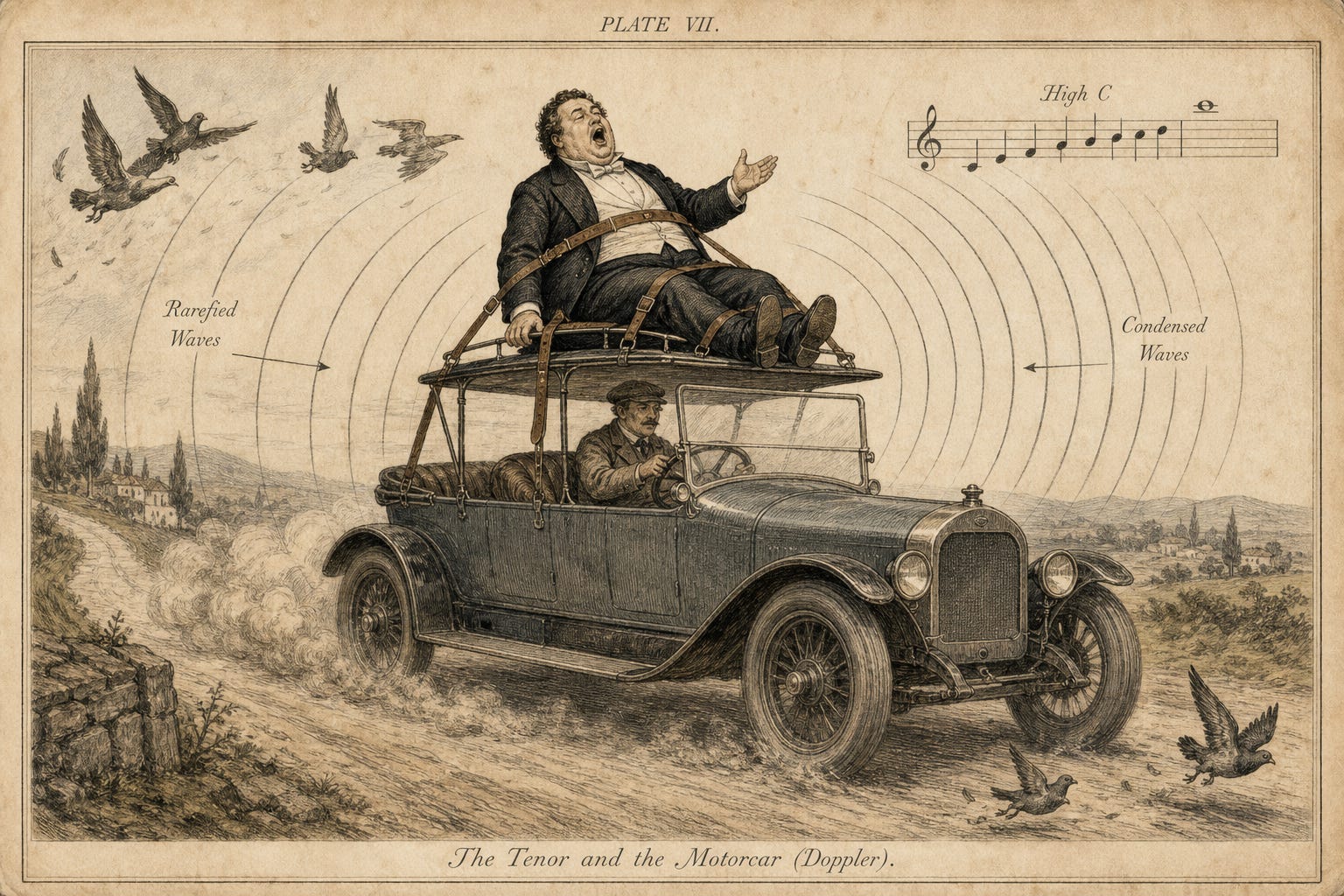
A moving train changes the pitch you hear through the Doppler effect. It does not add the train’s speed to the speed of sound in the air. Nobody finds this mysterious.
Strap a tenor to the roof of a speeding Alfa Romeo and have him sing a high C.
Please do not actually do this.
The Alfa compresses the wavefronts in front of him and stretches them behind him. The pitch changes… but the pressure disturbance still propagates according to the properties of the air.
You do not get:
speed of sound + Alfa Romeo + Italian emotional intensity.
The source changes the spacing of the wavefronts… the medium determines their speed.
So the first layer of light’s universal speed becomes almost embarrassingly ordinary: light travels at one speed because the vacuum has one shear stiffness and one specific effective density.
c is a property of the sea… not of the lamp, not of the star, and not of the atom that emitted the light.
The full relativity story is deeper than the moving-train analogy. I am not pretending that one tenor tied to an Alfa derives Lorentz transformations, time dilation, or the geometry of spacetime.
Even I have limits…
But the first supposedly impossible mystery… why the motion of the source does not simply add to the speed of light… vanishes.
Of course it does not.
The source does not set the propagation speed… the sea does.
And if the sea is the thing from which our rulers, clocks and matter are themselves constructed, then c is more than the speed of one phenomenon. It becomes the conversion rate built into every process made from that substance.
Not a number painted onto the universe… the universe’s own update rate.
Why Nothing Can Outrun It
Now assemble the trilogy.
In the first essay, the field became a state of the sea. In the second, matter became stable knots of the sea. And here, light becomes waves of the sea.
Fields. Matter. Light.
Three panels… one substance.
So what would it mean for a spaceship to outrun light?
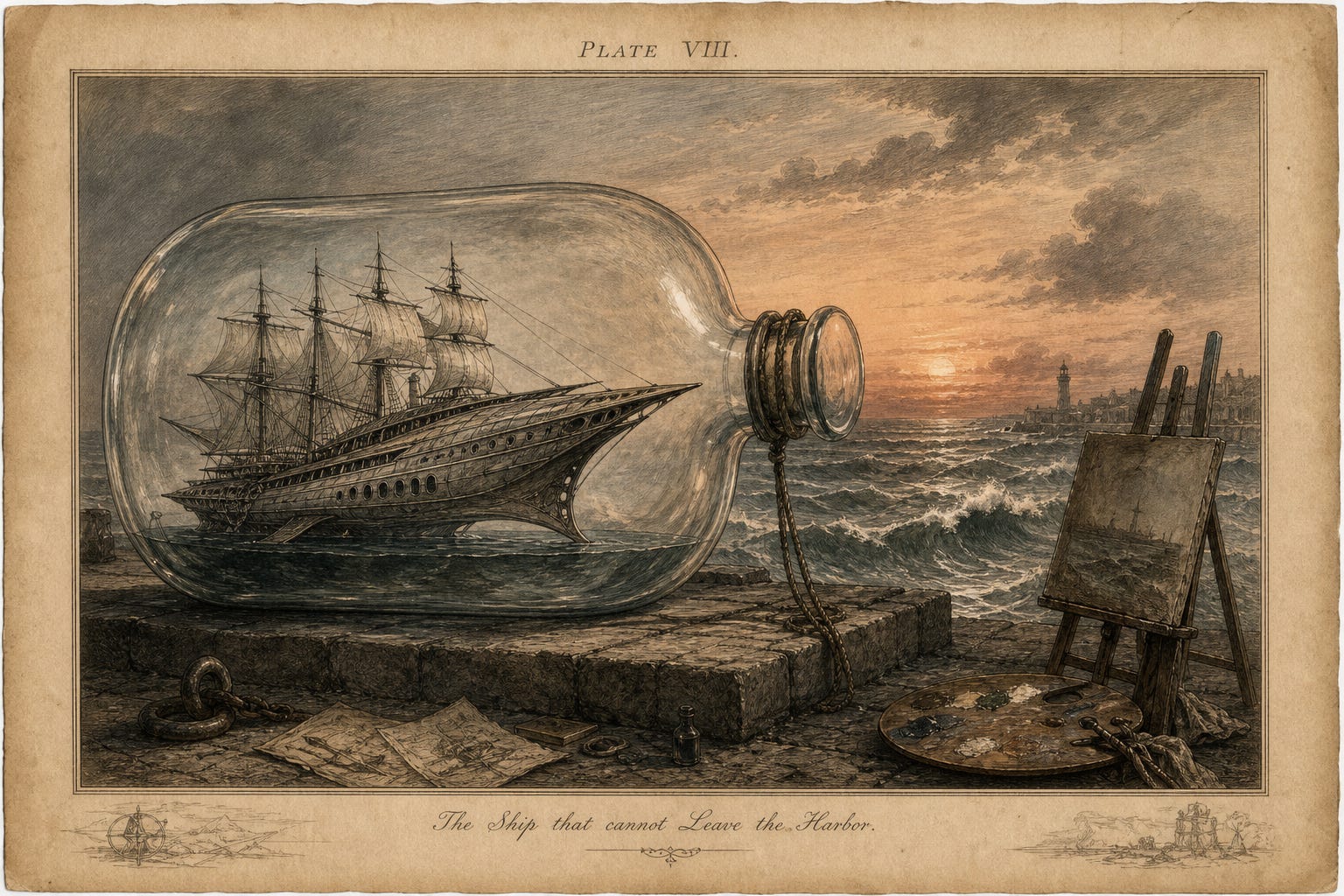
The spaceship is made of atoms. The atoms are stable patterns of the medium. The forces holding those atoms together propagate through the medium. The clocks inside the ship, the chemistry in the pilot’s brain, the electrical signals in the controls, the structural strength of the hull and the inertia of the entire machine all arise from that same substrate.
To accelerate the ship is to reconfigure those patterns. To outrun light would therefore mean forcing patterns made of the sea to propagate faster than the sea can transmit a change in itself.
Ma come? With what? Using which internal machinery?
The speed limit is not an externally imposed law… it is a tautology.
Nothing made of the sea can outrun the sea.
I realize this is terrible news for warp-drive enthusiasts. I am sorry. Believe me, it hurts me too: my first professional commission, at twenty, was covers of Star Trek novels… the Italian edition. I painted the impossible ship in oils and got paid for it. Thirty years later, here I am explaining why she can never go to another solar system in a few hours. Porca miseria! (damn it!)
But notice what we gained: The universal speed limit no longer looks like an arbitrary cosmic prohibition. It follows from what matter and light are.
Light moves at the sea’s propagation speed because light is the sea propagating. Matter cannot exceed that speed because matter is made from configurations whose reorganization depends on that same propagation.
The law was never: “Thou shalt not travel faster than 299,792,458 meters per second.”
The law is: “You cannot update the pattern faster than the substrate updates.”
Any programmer understands this immediately. You cannot overclock reality from inside the chip.
Try, and the object does not politely exceed the limit… its own internal bookkeeping ceases to define the same object.
That is not a traffic fine.
That is architecture.
“Michelson-Morley Killed the Medium”
We handled this in the first essay, so I’ll keep the reprise brief.
Michelson and Morley looked for a detectable wind produced by Earth moving through a stationary mechanical ether. They found none.
That killed the wind… it did not kill every possible physical substrate.
It killed one particular Victorian ether model. The medium we have been specifying is not ordinary air, honey or mechanical jelly. It has no state of uniform motion that matter can measure. Constant motion through it produces no drag, no directional change in the speed of light and no preferred inertial frame.
You can glide through it forever without feeling it… only acceleration and rotation announce themselves.
That is not a loophole invented after Michelson-Morley. It is one of the central requirements we already derived from inertia, Faraday’s disc and relativity.
The sea cannot behave like the old ether.
Agreed… that was the point.
“Then What Is a Photon?”
Here is the hint-level answer, because the full one deserves its own essay.
For now, digest this: waves inside bounded systems do not exchange energy in arbitrary smears.
Pluck a guitar string. It does not vibrate at every imaginable shape simultaneously. Its fixed boundaries admit specific modes… whole humps, half-wavelengths and harmonics.
The vibration is continuous… the permitted modes are discrete.
Matter is made of stable, bounded patterns. When a propagating wave interacts with one of those patterns, the exchange occurs in units set by frequency:
E = h f
Higher frequency… larger transaction.
The wave is the ontology.
The photon is the receipt.
That sentence is not yet the whole quantum theory. Calma, professori.
But it points toward a simpler architecture. A lump of exchanged energy does not require a tiny marble to have flown across the room.
When a bank transfers one thousand euros, no little sack of coins races through the internet, takes the motorway, pays a toll and arrives at your account slightly carsick.
The transaction is discrete… the infrastructure carrying it is not.
The medium carries the disturbance… matter settles the account.
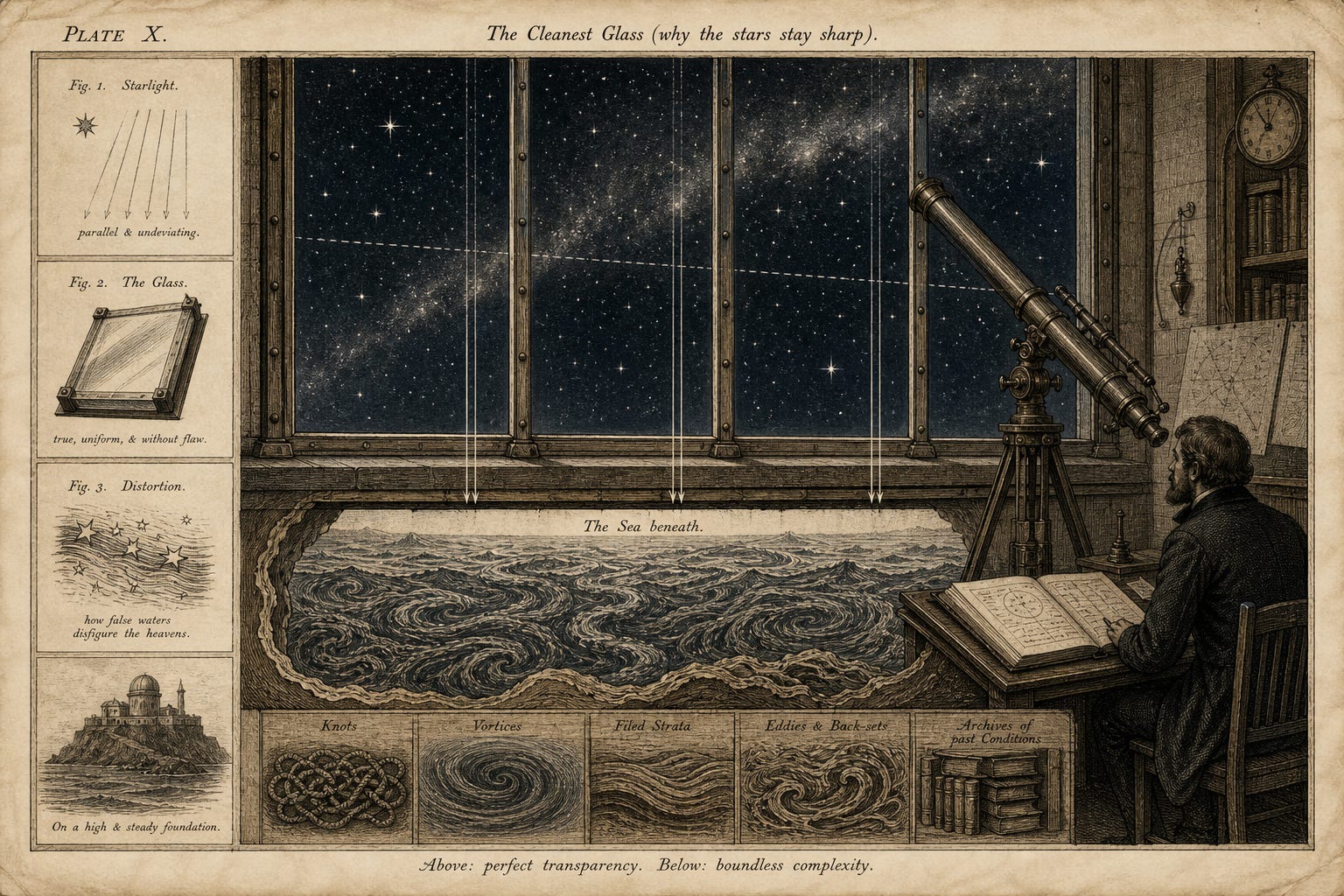
“Why Doesn’t the Structured Sea Blur the Stars?”
Because light does not respond to every structure in the medium. It responds only to the physical properties present in its own wave equation.
Light reads only one ledger… the shear ledger.
The rich hierarchy sustaining matter can live in the compressional ledger. If the shear response remains the same everywhere, light sees no boundary from which to scatter.
No contrast… no scattering… no milky sky.
We receipted this in the Faraday essay. The short version is that the sea can be structured in a sector light does not couple to while remaining perfectly uniform in the sector light does.
The darkness between the stars is not evidence that there is nothing there… it may be evidence that what is there is exquisitely transparent to its own waves.
Empty space may simply be the most perfectly clean glass anyone has ever mistaken for nothing.
What This Buys Us… and What It Does Not
Allow me to keep the books clean.
This does not prove that the vacuum is a medium. A convincing mechanism is not automatically a measured ontology. Nature is under no legal obligation to select the explanation that makes me slap my hands on my desk and yell “Eureka!”.
What this establishes is narrower…
Take four properties of light normally presented as separate fundamental facts: light is transverse, light has exactly two polarizations, light has no rest mass, and light propagates at one universal speed.
Under the medium picture, all four follow from one sentence:
Light is the transverse shear behavior of a physical substrate.
Why transverse? Because shear is transverse.
Why two polarizations? Because a forward direction in three-dimensional space leaves two sideways directions.
Why massless? Because the wave is not a separate object carried by the medium… it is the medium’s propagation.
Why one speed? Because wave speed is fixed by the constitutive properties of the thing doing the waving.
One physical statement… four consequences.
No modified Maxwell equations. No broken calculation. No additional particle hired to explain each property and then given a department and its own funding application.
That is explanatory compression… four mystery boxes collapsing into one physical picture.
And the picture carries a dangerous requirement, which is exactly what a physical theory should carry. If the transparent shear ledger is truly uniform, light’s vacuum propagation must be brutally clean.
No energy-dependent drift. No directional variation. No vacuum birefringence originating from an underlying lattice orientation. No gradual smearing of high-energy and low-energy “photons” over vast cosmological distances.
Astronomers have looked for those failures using radiation that has crossed billions of light-years… gamma-ray bursts, polarized light from distant sources, and photons spanning enormous ranges of energy.
The silence there… is extraordinary.
A naive crystal ether would already be dead. It would have left fingerprints all over the sky. High-energy photons would arrive early or late, polarization would twist, distant flashes would smear like cheap mascara in August.
They do not.
A medium that predicted ordinary lattice dispersion would have been murdered by astronomy before breakfast.
This model does not survive because its structure is simply too tiny to notice… it survives because light is blind to the ledger in which that structure resides.
The absence of dispersion is not an embarrassment patched over after the fact with duct tape and a supplementary appendix.
It is a demand of the architecture… and so far, nature has honored it.
Update the Specification
We began this series with a requirements document. It is now covered in coffee rings, swear words and arrows connecting things that physics textbooks keep in separate buildings.
Whatever space is, it must produce no wind under uniform translation, detect acceleration and rotation, allow field patterns to follow the physical state of their sources, remain transparent despite possessing internal structure, and make inertial resistance proportional to stored energy.
Now we add another line:
It must carry exactly one transparent wave sector: transverse, with two independent polarizations, no rest mass and one invariant propagation speed… and that wave must be what we call light.
Read the specification now.
The sea carries the fields. The sea ties itself into matter. The sea transmits light.
Fields are its states… particles are its knots… light is its wave.
The equations are not being discarded. They are finally being given something physical to describe.
For a century, physics told us that light crosses empty space. But perhaps “empty” was only the word we gave to a substance that would not show itself… a “void” where there is no dust to illuminate, no fog to scatter from, no surface to reveal its shape.
You have never seen light.
You have only seen what light touches. And perhaps, all this time, you have also been looking directly at the thing doing the waving. You called it empty space. You called it darkness.
But you have been looking at the sea your whole life…
You just called it the dark.