

[Interactive Explanations of the concepts in this article here: https://thefluxtheory.org/essays/haunts-physics-2/]
My left knee has recently begun “sending me invoices” from Vermont.
See, about fifteen years ago, when we were living there, I installed wood floors through basically our entire house. Which meant an absolutely stupid amount of time on my knees... measuring, cutting, fitting, hammering, standing up, kneeling down again, room after room. At the time everything seemed fine. I was younger. The knee was younger. Apparently we had very different understandings of the deal.
For years it said nothing. Now, every once in a while, it reminds me:
Robbè. About those floors...
And presents the bill. With interest... especially in the morning. No itemization, no customer service line, no possibility of dispute. Ouch!
This is not surprising. Everything does this. Shoes wear out, wood scratches, paint fades, bearings grind down, batteries stop holding a charge, mountains erode, stars run out of fuel. Leave anything in the universe doing something for long enough and sooner or later it keeps some record of the experience. Apparently my knee keeps excellent records. Better than my accountant.
And then there is the electron... hear me out:
The electron does not seem to have received this memo. As far as experiment has ever shown, an electron remains an electron. It does not slowly become a tired electron. It does not lose a little charge every billion years. It does not develop a wobble. It does not need reading glasses. It does not wake up one morning and regret flooring in Vermont.
Here is the part we say far too casually: as far as every experiment has been able to tell us, the electron is immortal. Eternal!
It has no childhood, no middle age, no retirement. The electrons around you survived stars being born and stars dying. They were here before Earth, before the Sun, before anything remotely resembling a human was around to give them a name. And through all of that... electron. Same charge, same mass, same spin, same coupling to light. No ageing we can detect. No fatigue. No wobble. No slow fading away... and certainly no knee.
Strictly speaking, physics has not proved that an electron can never decay; experiments can only keep pushing its possible lifetime farther out. But as far as nature has shown us, the electron is the closest thing physics gives us to an immortal object.
And once you stop and take that seriously, it is weird. Insanely weird.
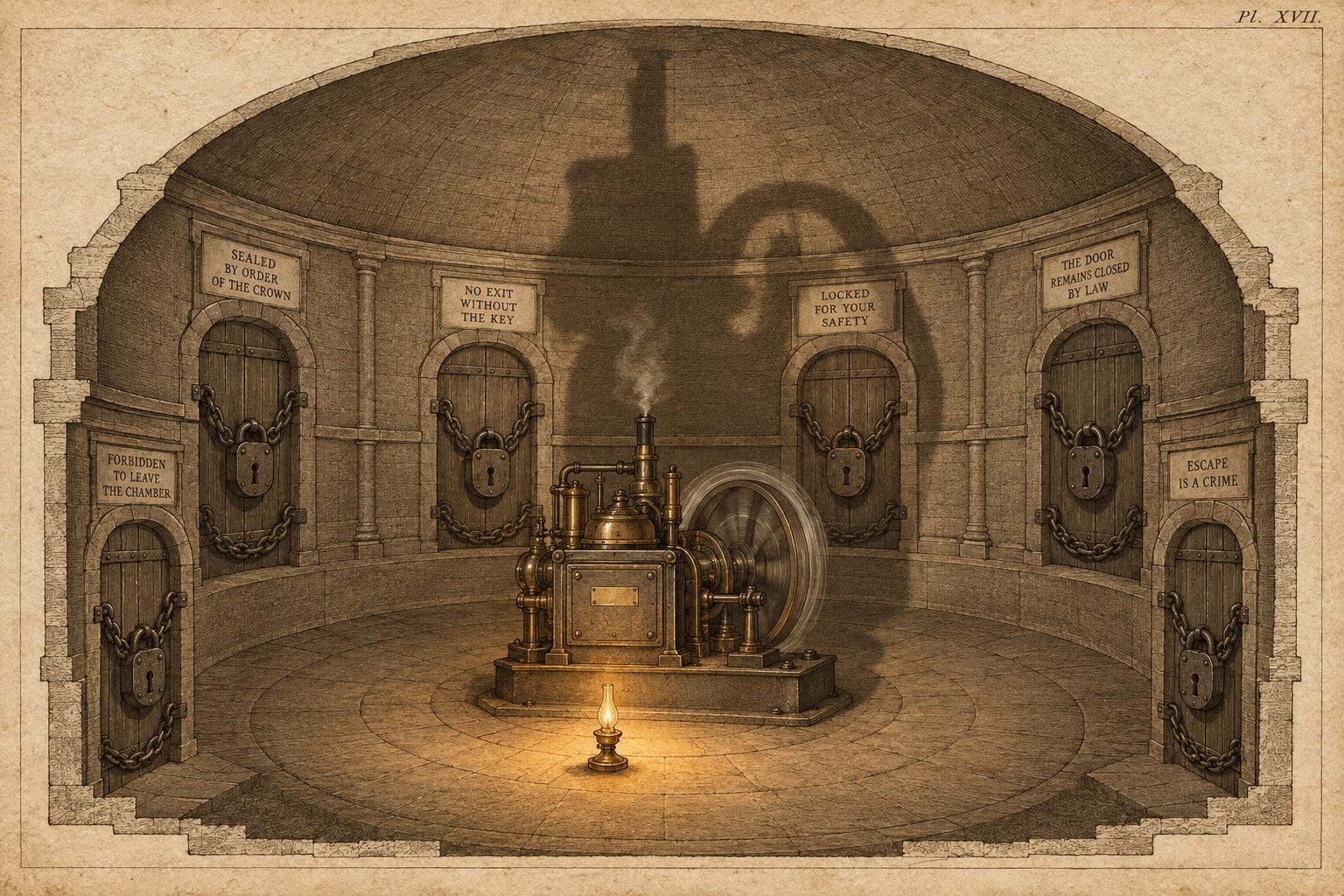
Physics Has an Answer. Sort Of.
Physics does have an answer to part of this. The electron is the lightest thing in nature that carries electric charge. To fall apart, it would have to hand that charge to something lighter... and there is nothing lighter to hand it to. So it stays. Fine. Useful, sure.
But notice what happened. We asked why does this thing survive? And the answer is essentially: because it is not allowed to turn into anything else.
Ma dai! (Come on!)
That is not an explanation!
It is like asking why an engine has been running for billions of years without wearing out and being told, “Well, it can’t become a smaller engine.” Okay. Thank you. Very helpful.
But why is it still running? What is happening inside it?
The electron has a charge, a mass, a spin, a rhythm of its own, and a very particular grip on light. Measure all of these beautifully. Write them down. Build insane mathematics around them. And eventually the explanation becomes the list. I keep running into versions of this in fundamental physics: fundamental facts with huge questions attached to them, questions everyone stopped asking a long time ago. Not because they were answered. Because everybody got tired.
So, I keep seeing a little sticker on the side of the box:
MECHANISM NOT INCLUDED.
Like batteries on a Christmas toy, except the toy is the universe and the shop closed thirteen billion years ago.
Naturally, I want to open the box!
It Ticks. And It Needs Two Turns.
Two more strange facts, and then the number.
Nearly a century ago Louis de Broglie noticed that if you put two famous ideas together, something interesting happens. Einstein says mass is energy. Planck says energy is a frequency. Put the two together and you get something strange: an electron sitting perfectly still, doing absolutely nothing, still has a beat.
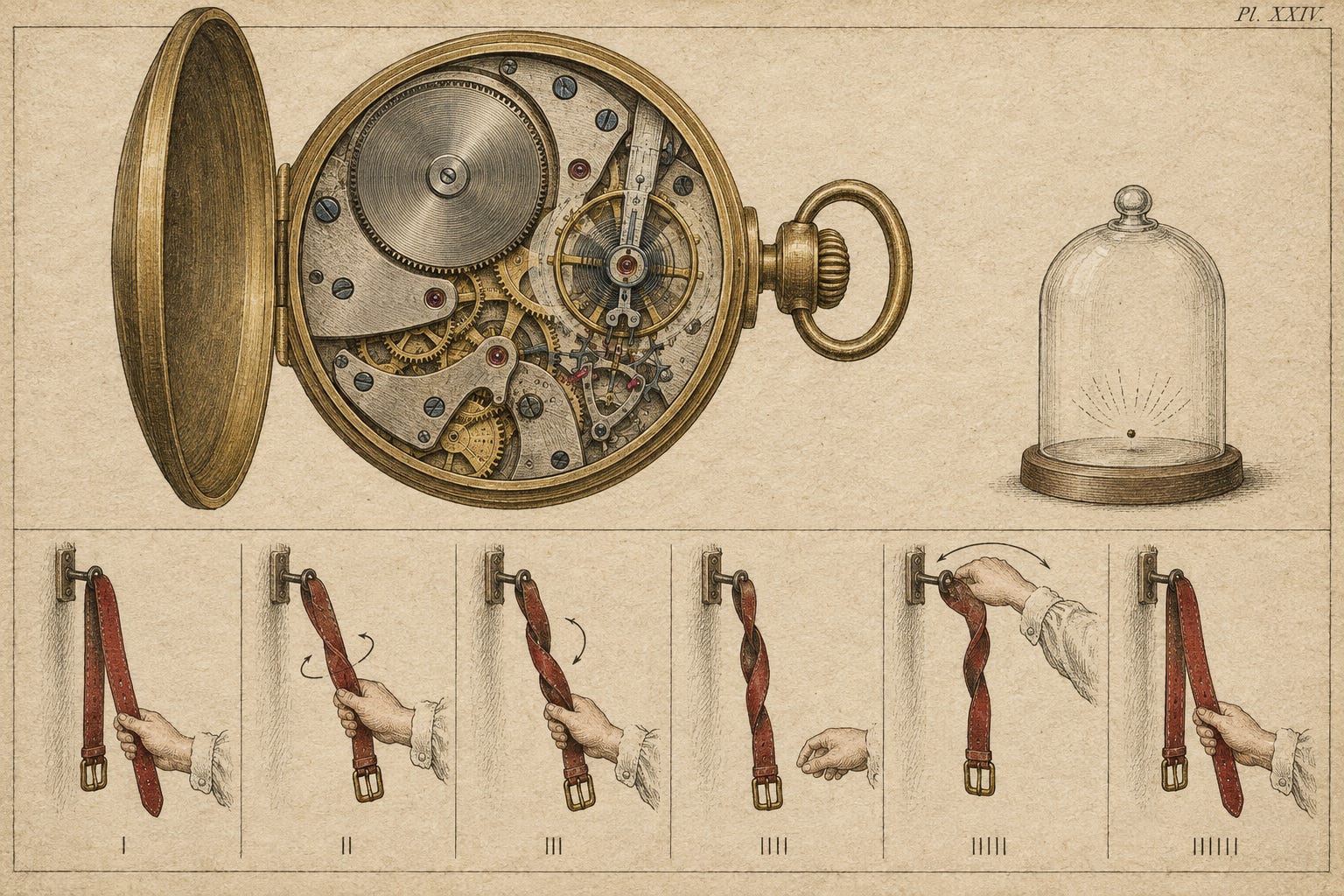
A rhythm. A matter clock, in de Broglie’s language... not literally a tiny clock ticking inside the electron, but a natural rhythm belonging to the thing. And it is absurdly fast: on the order of 10²⁰ cycles per second, a one followed by twenty zeros. As a musician, I can tell you that is not a tempo. That is a hostage situation for the drummer.
Then there is spin. Unfortunate word, because everybody immediately pictures a microscopic ball spinning on its axis. It is not that. Electron spin is stranger. Turn an electron all the way around once, a full 360 degrees, and it is not back where it started. You have to turn it around twice. 720 degrees. (Physicists call it “spin-½,” which sounds like a detergent.)
If you have a belt or an old charging cable you are willing to abuse, you can demonstrate something related with your hands: one turn leaves you twisted, and with a second turn and the right motion the twist disappears. The first time you see it, it looks like somebody cheated. Physics occasionally does that. (If your family asks what you are doing in the kitchen with a belt, tell them it is quantum mechanics. It will not help, but it will end the conversation.)
So now we have a suspicious collection of facts. The electron does not wear out. It has a natural clock. Its spin needs two turns to come home.
And then there is one more thing.
Ah Yes. That Number Again.
137.036... the number from my earlier post. Physicists call it the fine-structure constant (well, one over it, but let’s not be fussy). It is the number that decides how hard light and charged matter grab each other.
Change it and you do not just alter something buried in a physics handbook. Atoms change. Chemistry changes. Stars change. You and I probably would not get to have this conversation... which, depending on how you feel about this article so far, may or may not be a loss.
Physics knows the value to ridiculous precision. Why that value? Well... put it into the equations and shut up! See, the equations work beautifully, next question please...
As a programmer, I find this offensive.
If I open some ancient piece of production software and find
137.035999
buried in a configuration file, with no explanation, no derivation, no commit message, nobody currently on the team who knows where it came from, and half the program breaking if I touch it... I do not become less curious because the software works. Quite the opposite. Who put this here? Why this value? What else depends on it? And what sort of psychopath left no comment?
So I run git blame. Author: the Big Bang. Date: 13.8 billion years ago. Commit message: “misc fixes.”
Anyone who has maintained old code knows the particular horror of the line that effectively says: DO NOT CHANGE THIS. NOBODY KNOWS WHY IT WORKS.
That was roughly where my previous article ended. At the time I thought 137 was the mystery. What I did not understand was that the electron’s persistence, its clock, its two-turn spin and that number were about to start leaning toward one another... like old men on a bench in a Roman piazza, all suddenly very interested in the same gossip.
Start With the Loop
At some point in the electron work I had to choose where to begin. Every theory eventually does this. You keep asking why until you reach something and say: va bene. Start here.
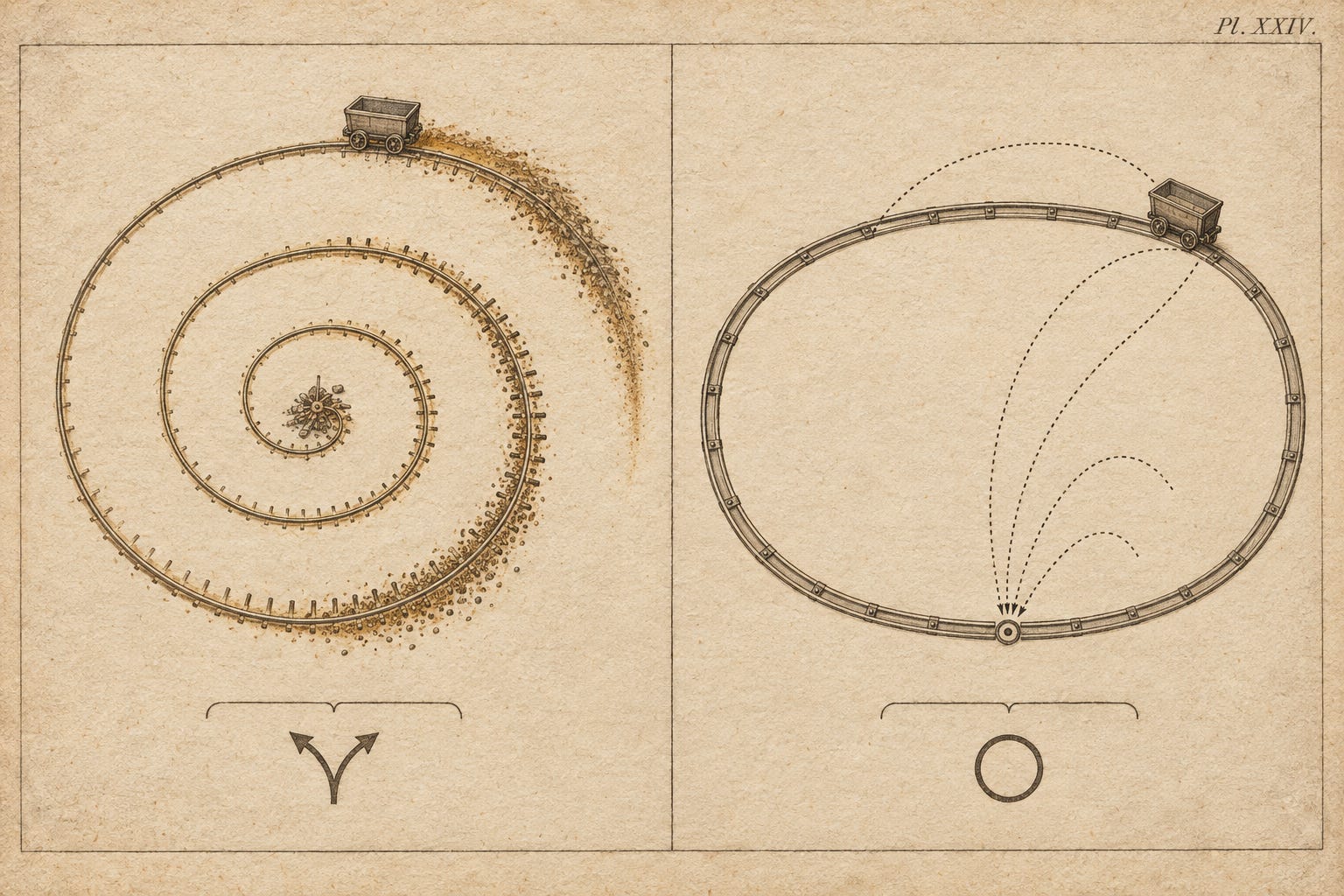
The starting point in Flux is simple. The electron is a loop. A process running in the fabric of the vacuum itself... not a little ball sitting in empty space (sorry, every school chemistry poster ever). It runs. Things change along the way. And then it comes back to exactly where it started, ready to go again. Then again. Then again. That is the starting assumption. And in the current math, it comes back exactly. Not almost. Exactly.
That is almost all I want to say publicly about the internal mechanism for now, because the interesting part is not the blueprint. It is what starts falling into place once you take the loop seriously.
Let’s think back to my knee for a second. My knee wears out because one cycle is not identical to the next. Tiny consequences accumulate: one floorboard, another, another, fifteen years, invoice (oh... the pain!). But maybe the electron does not survive because nothing happens to it. Maybe it survives because every cycle brings it back to exactly the state it started from, ready to begin again. That is a completely different picture of persistence. The electron is not tough. It is tidy. It cleans up after itself, every single time, which is more than I can say for anyone who has ever shared a kitchen with me.
And suddenly the clock is less mysterious. A repeating process naturally has a rhythm... there is actually something repeating. Then spin gets interesting too, because the Flux loop has the same two-turns habit: go around once and you are almost home. Go around twice and you are home. And here is a bonus I did not expect: that same two-turn habit is where the famous one-half in “spin one-half” comes from. The half is not a label someone stuck on the electron. It is the loop counting its own laps.
At this point I was already getting uncomfortable. Then 137 came back.

And Then the Number Falls Out
This is where everything changed for me.
The electron loop is not allowed to do whatever it likes. It lives inside a very constrained structure, and Flux itself is deliberately constrained: a tiny kernel of rules that has to keep doing all the work. You do not get a fresh set of adjustable knobs every time the next problem gets difficult. Electron? Same box. Electromagnetism? Same box. Gravity? Same box. Chemistry comes knocking? Porca miseria. Same box. Otherwise, given enough knobs, we can eventually make numbers confess to almost anything. Give me enough knobs and I will derive the price of a cappuccino in Milan from the mass of the Moon.
So the recent work followed the mechanics of the electron under those fixed constraints. And when the calculation finally closed, sitting at the end was:
137.036033...
The experimental reference value is 137.035999... The difference is roughly a quarter of one part per million. Imagine a road one thousand kilometres long, Milan to somewhere past Naples; at that scale, you miss the far end by about twenty-five centimetres. Roughly one panino.
Yes, I care about the panino. Very much. Those twenty-five centimetres are perfectly capable of ruining several otherwise pleasant evenings. But they are not what made me sit back from the computer...
Because the number itself had already appeared in the earlier Flux geometry. What changed is that the mechanical explanation underneath it arrived at the same place. The number did not move. The mechanism closed underneath it.
Think about an old mechanical clock. You watch the hour hand go around once every twelve hours, so you write down: 12. Correct. Then one day you open the back. You see the gears. You count the teeth, follow how one wheel drives the next... and the gears give you twelve. Now “twelve” has changed status. It is no longer a number measured from outside. It comes from how the clock works.
That is what just happened to 137 inside Flux.
This Is Much Bigger Than 137
I need to stop being casual about what I am describing, because I have been writing about 137 as though the exciting part is that Flux got a famous number right. That is not the exciting part.
Not anymore.
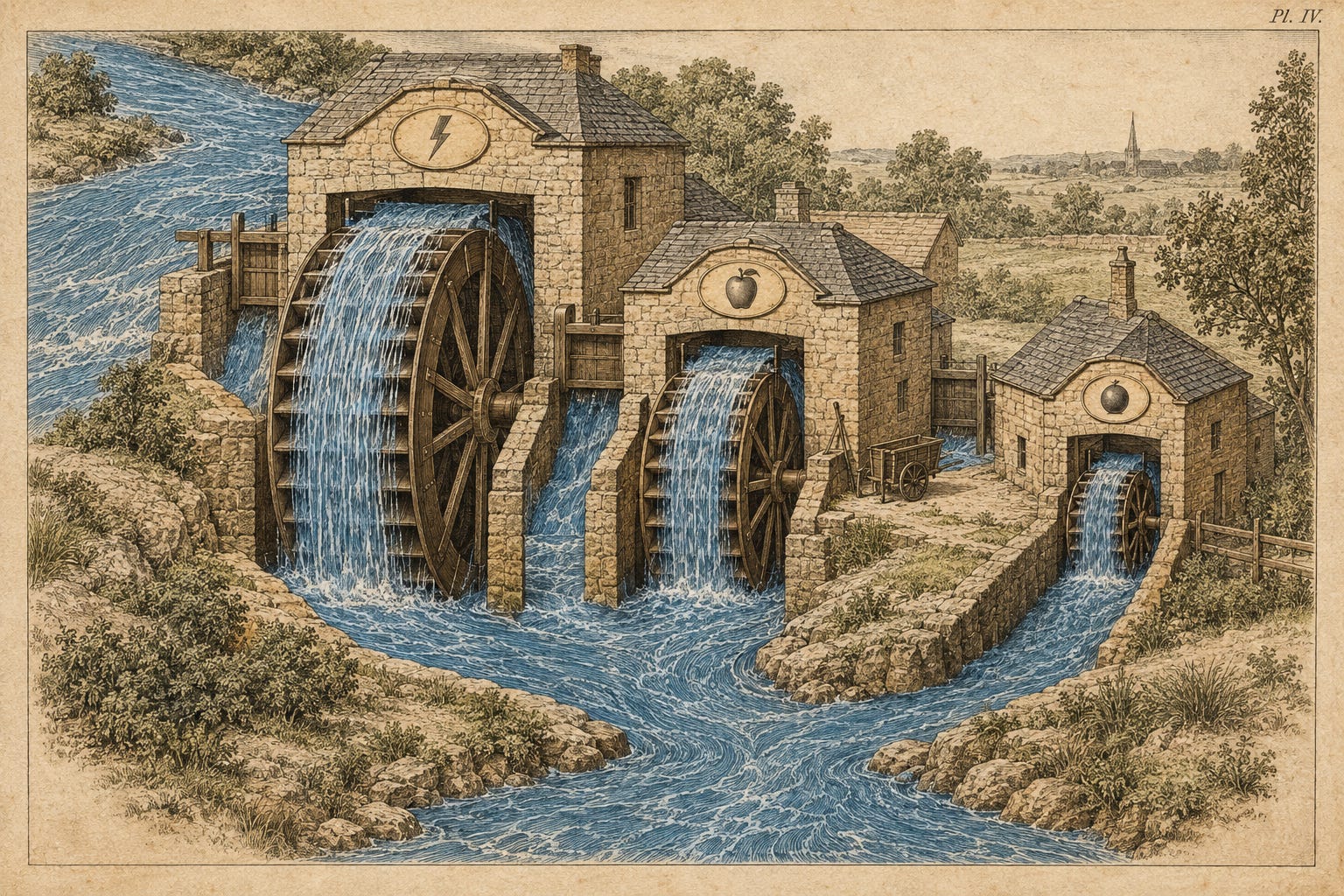
Flux had already done something strange before this mechanical work began. The geometry had tied together quantities physics normally keeps in completely different buildings: the electron’s mass, the atomic scale, gravity, the absurd hierarchy between gravity and electromagnetism. Walk into the machinery through any door you liked, and you kept ending up in the same room.
That was the original shock of Flux Theory... the geometry insisting these things are not independent; they only look independent because you are seeing them from different ends of the machine.
At the time, that was mathematics. Very suggestive mathematics. Sometimes frankly ridiculous mathematics, the kind where you stare at two results from opposite corners of physics and think no, come on, rerun it, make a coffee, rerun it again, and get annoyed because it happens again.
But underneath all of it sat one very important question: why should nature care about this geometry? A geometric relationship can be beautiful. It can compress an astonishing amount of data. But at some point you still have to ask what is physically happening.
Where is the machine?
That is what has changed. The geometry was already the map. Now, for the first time, I am beginning to see the machinery that makes the map physical. And it is showing up in more than one place at once.
Electromagnetism.
Start with 137, one of the most famous unexplained numbers in physics, measured and confirmed for a century to absurd precision. Inside Flux, it is now emerging from the vacuum mechanics themselves... not from fitting the number, not from typing alpha into the calculation and congratulating ourselves when alpha comes back out wearing a different hat and a fake moustache. The same fixed structure that supports the electron loop produces the electromagnetic coupling.
That alone would be enormous. But it is not alone!
Gravity.
Now go to the other end of physics: the weakest force by an almost comical margin. You defeat the gravity of the entire planet every morning just by picking up your espresso cup. Between elementary particles it is so feeble that its gap from electromagnetism is measured in something like forty orders of magnitude. For decades one of the great dreams has been to understand why these two forces are so grotesquely different in strength, and why gravity belongs in the same universe as quantum matter at all.
Flux had already connected that hierarchy geometrically. But now the gravity side has moved. In the current construction, gravity is simply how the vacuum reacts to matter being there... sitting at rest, carrying its energy. And that forty-orders-of-magnitude chasm between gravity and electromagnetism? It comes out of counting pieces of the structure. Not fitting. Counting. Then give it one ruler, the electron’s mass, and that count returns Newton’s constant at 6.674312 × 10⁻¹¹, about 1.8 parts per million from the measured value.
Or run it the other way.
Give it Newton’s constant and Planck’s constant instead, just to set the units, and it hands back the mass of the electron to under one part per million... without ever having been told the electron’s mass.
And that tiny miss? Newton’s constant is one of the worst-measured numbers in physics. The uncertainty in G alone blurs the electron’s mass by about fourteen times more than the gap. In plain words: the miss is smaller than the wobble in the ruler.
Sit with that for a second...
On one side, the strength of electromagnetism. On the other, the strength of gravity. Two forces we have spent a century trying to reconcile... and both are now pointing back toward the same vacuum architecture.
This is no longer “look, Roberto found another interesting number.” This is: why do two of the most fundamental interactions in nature seem to be coming out of the same machine?
Inertia.
And beside them, inertia... the thing you feel every time you push something heavy. Anyone who has ever push-started a dead Fiat Panda on a Roman hill in August knows inertia personally, and has opinions about it. Newton gave it a magnificent rule and no mechanism. Why does matter resist acceleration? Why should the same thing that stores energy also push back when you try to change its motion?
Flux had already linked this geometrically through the same structure. Now the vacuum side of that question has closed too. How hard the vacuum resists being shoved, and how springy it is when shoved, both come out of the same counting that gave us gravity. And they arrive with one detail I did not order: ripples through it still travel at exactly the speed of light. The stage does not merely hold the actors up. Shove one, and the stage pushes back... at a rate the same machine fixes.
Right now, the machine can tell you what a motion costs. It cannot yet tell you which motion the electron actually picks. It is like a taxi meter that works perfectly... but nobody has told the driver where to go. That piece is still open, and I will name it again below, because it is the same open piece everywhere. Of course it is. At this point I would be more surprised if it lived anywhere else.
So here is the part I have not communicated strongly enough.
Flux did not begin this month as three separate theories that I am now trying to staple together.
The unification was already in the geometry.
What I did not have was the physical story underneath it. The geometry was saying they are one problem. The mechanics is beginning to say yes, and here is why.
And frankly, this is bigger than the “holy grail” language we usually use for unification.
Putting gravity and electromagnetism into one formalism would already be historic.
But if the same physical vacuum mechanism explains why matter persists, why it has an internal rhythm, why spin behaves the way it does, why electromagnetism has its particular strength, why gravity has its vastly weaker one and why matter pushes back when you push it... then we are not merely unifying forces. We are finding out that what looked like separate laws of nature are one thing, wearing different outfits.
That is the prize. Not a prettier equation or another particle.
Fewer fundamental things.
Which is what physics has always been trying to do. Newton took the falling apple and the Moon and said: same thing. Maxwell took electricity, magnetism and light: same thing. Einstein took gravity and geometry: same thing. De Broglie looked at a particle and saw a wave. The deepest advances have repeatedly come from discovering that phenomena we gave different names were never separate in the first place.
That is the standard I am measuring this against. And if what is happening inside Flux survives, the vacuum may be about to do it again. Electromagnetism. Gravity. Inertia. Matter itself. Not four mysteries... four consequences of one structure.
Madonna mia. Now that is why I have not been sleeping!!! The cats have noticed. They are not impressed. They want breakfast at 7 a.m. regardless of the fine-structure constant or not!
“Vacuum” Is Starting to Sound Like a Terrible Name
Most people hear vacuum and think empty. Space after you remove the stuff. Modern physics already knows it is not that simple, so I am not announcing that everybody forgot about quantum fields. But our intuition still puts the interesting things in space.
Particles are the actors. Vacuum is the stage.
Flux keeps making that picture harder for me to hold. If the electron is a repeating process of the vacuum, if the vacuum carries that process, and if the strengths of fundamental interactions are emerging from the same structure... then the stage is doing an awful lot of acting. At some point you have to stop calling it scenery. Calling it vacuum starts to feel like calling the ocean “the wet bit between the boats.”
Think about a wave in the sea. You cannot fully explain the wave while pretending the water underneath is irrelevant. The water determines which waves are possible, and the wave in turn tells you something about the water. Maybe these constants are doing the same thing. Maybe they are not arbitrary labels attached to matter. Maybe they are telling us what the vacuum itself can do.
That, to me, is the much bigger discovery hiding behind 137.
Send It Somewhere Else
There is, of course, an obvious danger. If I build an elaborate machine specifically to produce 137 and then announce look! it produces 137!... please take the laptop away from me. That is not physics. That is arts and crafts. With glitter (which I happen to hate!).
A costume sewn to fit one body looks perfect on that body. Put it on anyone else and it splits at the seams. So the only honest test is to take the machine somewhere it was never fitted for, and watch the seams.
First stop: hydrogen. Put two hydrogen atoms together and there is a particular distance they prefer... like two strangers sharing a sofa. Too far apart and there is no conversation, the bond disappears. Too close and the elbows start, they push back. Somewhere between is the comfortable distance. Here is the important part: nobody tells the calculation where that distance is. No ruler, no hint, no “stop around here.” It has to find it. And it lands very close to the observed bond length, and to the energy it takes to pull the two apart.
Then helium. Put a helium atom in an electric field and its electron cloud shifts slightly... give the atom a gentle shove and ask how much it gives. The calculation gets that response close to the accepted value. But the part I trust most is the other experiment: take out one interaction that should matter, and the answer goes badly wrong. That is exactly what you want. A machine that still gets the right answer after you rip out a real piece of it is not doing physics. It is doing theatre.
And then I did something slightly unhinged.
I took the same geometric kernel that first produced 137... same box, same rules, not one new knob... and built an engine on top of it. It is called FluxMateria, and its whole job is to answer the questions chemists and materials scientists actually ask, all day long. Questions nobody had in mind when those rules were written. No machine learning. No training data. No fitted parameters. One ordinary computer, single-threaded, no GPU.
A costume tailored to 137 should have split at the very first molecule. Here is what came back instead.
Bond lengths. 453 chemical bonds across 64 elements: average error 0.079%. The distance between two atoms, predicted to within less than a thousandth of itself.
The raw test. 1,483 measured experimental and reference values, raw formula outputs only, no calibration of any kind: average error 0.176%.
Twisting molecules. Rotate part of a molecule around one of its bonds and it costs a little energy; chemists call it a torsion barrier. The standard tools for this are force fields, programs fitted parameter by parameter to mountains of data. On the same 99 measured barriers, with zero fitted parameters, the engine is 9 to 13 times more accurate than three of the best-known ones. The fitted tools lost to the unfitted one on their own home turf. Ma dai.
Against quantum chemistry itself. Head-to-head with DFT, the workhorse of computational chemistry, on 15 classic materials, identical inputs, run on my own machine. DFT’s standard flavour is famously bad at band gaps (to be fair, everyone knows this, which is why people patch it) and misses by a median of about 50%. The engine’s median miss: 1.2%. And it gets there roughly twenty thousand times faster.
The one I love. How well a drug molecule passes through the cells of your gut is one of those questions where the best published result comes from machine learning trained on the answers. Pure physics, zero training labels: 0.277, against the trained-ML record of 0.276. A tie... from a machine that was never once shown the test.
Is it perfect? Figurati. Silicon carbide stubbornly refuses to cooperate on how fast electrons move through it. Heavy-element semiconductors are still the hardest cases. Some panels fail their own tests. There is still work to do on emergent physics only protein folding and DNA…
Every number above is published, with its dataset, its metric and its methods: fluxmateria.com/benchmarks. And the blind track is open. You pick the molecules, I freeze the predictions before seeing a single answer, you do the scoring.
The successes tell you the machine works. The failures tell you it was never fitted to make you believe it.
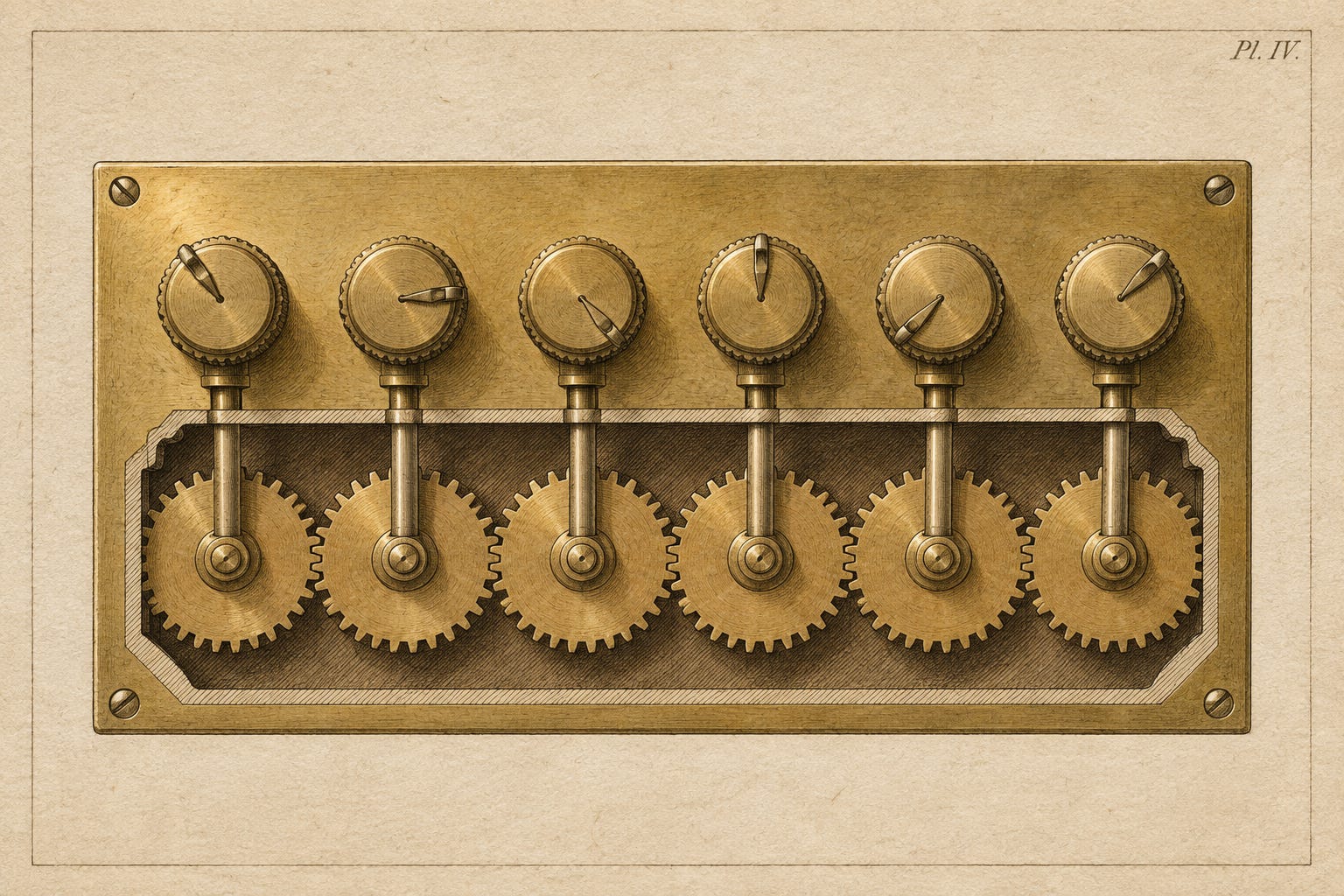
Maybe the Knobs Are Gears
And now I keep coming back to that clock.
Modern physics contains a collection of quantities we measure and then hand to the theory: masses, interaction strengths, mixing parameters. They look like independent settings. Maybe many of them are. But once one famous setting starts behaving like a consequence of deeper machinery, you naturally start eyeing the others. What if nature never chose 137 separately? What if, once the underlying structure is what it is... 137 simply comes with it?
Think about baking bread. You take the finished loaf and measure it: nine centimeters tall. That is a real property. But there is not a tiny LOAF HEIGHT dial hidden in the oven set to nine centimeters. The height follows from the ingredients, the pan, the temperature, the timing, and whether Debbie the sourdough starter has decided to cooperate today. (Debbie has moods. Debbie is, frankly, less predictable than quantum mechanics.) The process produces the property.
So how many quantities that currently look like inputs to physics are really outputs of something underneath? Twenty? Ten? Three? One? I have no idea. Maybe 137 is unusual. Maybe it is the first loose thread and half the sweater comes with it. That uncertainty is exactly why this is interesting. The question has changed. Not why did the universe choose these settings? but how many of those settings were ever independent in the first place? That is no longer philosophy after dinner, with a grappa. It is becoming something we can attack.
One Brake Pedal
Senti. (Hear me out.)
Nobody has yet proven, by experiment, that the vacuum really works the way Flux says it does. The 137 result closes inside the theory, playing strictly by its own rules... which is a real achievement, but it is also Flux checking its own homework. Someone else still has to check it. Gravity has moved a long way, and the vacuum’s push-back has now closed right beside it.
Two things the machine has not yet answered. The first is motion itself: the electron loop I described is worked out sitting still, and the machine can price a trip without yet choosing one. How the electron travels through the vacuum, and how it holds itself together while it does, is still open... and right now that is the question I spend my nights on. The second is size. In the vacuum’s own units, every ratio in this article is derived, the electron’s mass included. But how big one vacuum cell is in metres, the machine cannot yet say on its own. It still borrows one measured number to set the ruler. Every ratio, no ruler... yet
There are open pieces. Good. I want them visible. A theory that suddenly has no unanswered questions is usually no longer a theory. It is a religion.
But I also refuse to make what happened sound boring simply because the work is unfinished. The geometry had already told me these were one problem. What has changed is that the vacuum is beginning to tell me why.
Last time I thought 137 was the mystery. Now I think it may be the clue. Because if these numbers really come from the same underlying vacuum, then the question is no longer why is electromagnetism 1/137? It is:
What the hell is the vacuum doing that makes all of this come out together?
Unfortunately, that is a much bigger question. My knee has already sent the estimate.
E ti pareva! (Of course!)
Interactive Explanations of the concepts in this article here:

Roberto Campus (born 1974, Sardinia) is a coder, composer, visual artist, and entrepreneur who’s spent 35 years obsessing over the mysteries of the universe. Grew up in Rome with stubborn questions and an insatiable curiosity. He’s either onto something profound or needs a better hobby. Possibly both. Time will tell.