
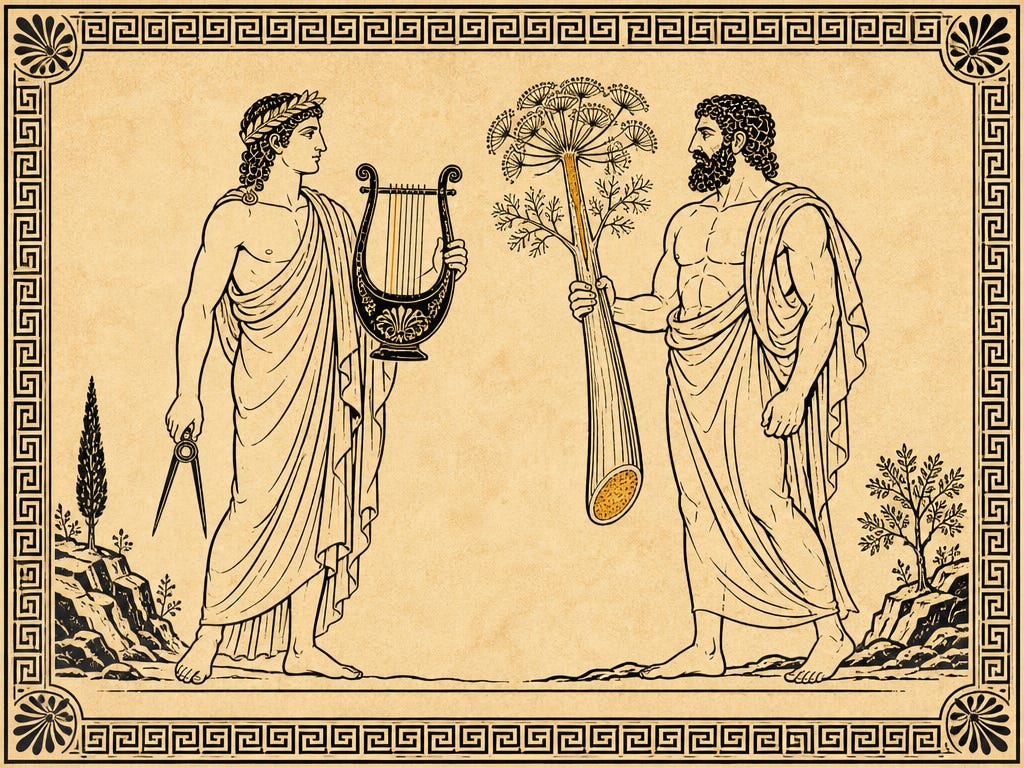
Two gods have been pulling on this project since before it had a name.
I mean that quite literally!
I realize this is an unusual way to begin an essay about physics. If you have been reading my posts for a while, however, you should know by now that I am perfectly capable of spending the morning trying to kill a derivation, the afternoon writing code specifically designed to attack it and sometimes… the evening wondering whether Apollo has been trying to tell me something for the last two years.
These things do not contradict each other in my house.
They do live in different rooms. A claim I can check goes in the ledger, where it can be attacked and killed. A claim I cannot check goes somewhere else. Not a lower shelf. A different room. The only real mistake is pretending the two rooms are the same one. Science and spirituality can live perfectly parallel lives.
Right now il piccolo, the home PC under my desk, is humming away. My Border Collie is asleep underneath the desk, wedged into her usual impossible space between my legs and the wall, where she somehow manages to spend hours while I work. She has decided that this is also her job. I do the physics. She supervises unconsciousness I guess.
Outside, somewhere beyond the dark, is vineyards and a bit farther, the Mediterranean.
And on the desk are the two forces that have governed almost everything I have done with Flux Theory.
Prometheus <> Apollo.
Fire and measure.
The method I use now is mostly the record of learning to keep them apart.
Prometheus Is Not Really About Fire
We remember Prometheus as the fellow who stole fire from the gods. That is the dramatic part, obviously. Human beings love theft, divine punishment and somebody getting chained to a rock.
But his name is more interesting than the crime.
Prometheus means forethought. The one who thinks before. He is older than the Olympian order, a Titan, and his defining act is not simply that he gives humanity something powerful.
It is that he gives it before permission arrives.
That matters to me, because nearly every dangerous impulse in this project has had a Promethean shape. Start underneath the existing framework instead of asking it for permission. Build the working thing before everyone agrees on what to call it. If you can make the fire burn, give it to people and argue about the metaphysics around the hearth later.
And when I get frustrated… madonna mia… this impulse gets much stronger.
There are days when I am trying to solve a piece of physics I barely knew existed before it landed in front of me. I am learning as I go. Sometimes that means opening a paper and discovering that before I can understand the thing I actually came for, I first need to understand another thing, which requires another thing, which turns out to involve calculus I never properly learned, and suddenly it is six hours later and I am forty tabs deep into a mathematical education I did not know I was signing up for that morning.
There are moments when I genuinely want to throw the entire project into the sea.
Not metaphorically. The sea is nearby. This could be arranged.
And then there are the other moments. The ones that make the whole thing dangerous.
A derivation that has refused to move for days suddenly collapses into something simple.
Two pieces developed months apart turn out to be the same piece of machinery seen from opposite directions.
A quantity appears where I had not put one in.
Something clicks.
And for about thirty seconds I am twelve years old.
Eccolo. There it is.
Those moments are extraordinary. They are also when Prometheus gets loud.
Just publish the whole bloody thing. Put it online tonight. Mechanism, derivations, unfinished edges, all of it. Let ten thousand people attack it at once. Somebody will find the mistake faster. Somebody else will see the thing I missed. Stop guarding it, stop sequencing it, stop waiting for some imaginary perfect moment.
Get the fire down the mountain.
Now!
And there is another voice underneath that impatience which is harder to dismiss.
Responsibility.
Because suppose the thing is actually onto something. I do not mean suppose every equation is right, or every interpretation survives, or that I woke up one morning in Sardinia having accidentally solved physics before breakfast.
Calma.
I mean something narrower. Suppose there really is a piece of physical structure here that we have been missing.
Then what exactly am I doing sitting alone at a desk with it?
That thought has weight. There are days when withholding anything starts to feel morally absurd. If you found something useful, you share it. If there is fire, people need fire.
Prometheus is the part of me that feels that responsibility as urgency.
But this is where the problem becomes more interesting than the mythology, because knowledge begins creating obligations before certainty arrives.
We like to imagine the sequence differently. First you know. Then you become responsible for what you know. Frontier work is not so tidy. It sucks, royally, actually.
Sometimes you have something that might matter long before you possess enough certainty to know what your duty toward it actually is. If I am wrong, I have an obligation not to manufacture certainty and send other people chasing my mistake.
If I am right, I have an obligation not to bury something useful because I was afraid of looking ridiculous.
Those two obligations point in opposite directions, and there is no equation that tells you when one has overtaken the other. That is where judgment enters.
Prometheus is the part of me that wants to be generous before I am allowed to be.
I do not mean generous in the saintly sense. There is ego mixed in there too. Of course there is. Anyone claiming otherwise while developing a theory of fundamental physics should probably be searched for hidden incense. There is generosity in wanting people to have the thing, and impatience, and the very human desire to say:
Look. Look what I found!
Apollo has a different temperament.
Apollo Brings a Ruler
The two most famous sentences associated with Apollo’s sanctuary at Delphi are not mystical instructions. They are almost annoyingly practical.
Know yourself.
Nothing in excess.
No believe. No obey.
Measure.
And before you measure the world, measure the idiot holding the instrument.
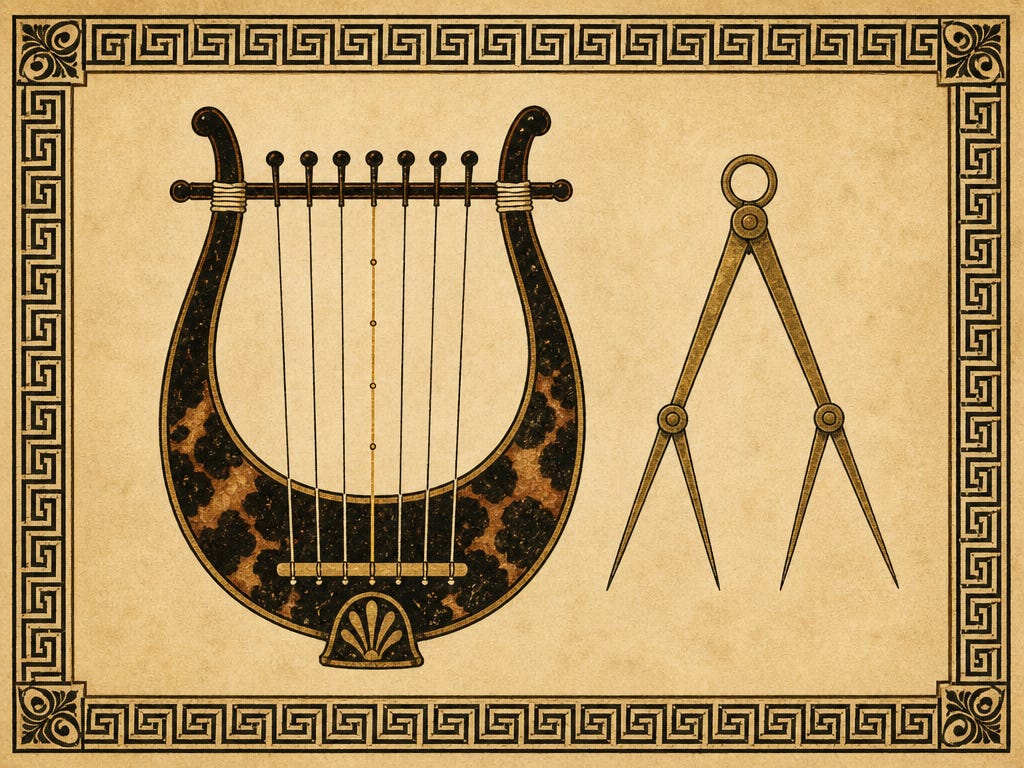
That is much closer to the Apollo I understand. Apollo carries a lyre, and a lyre is basically a machine for turning proportion into beauty. Move the division of the string and the interval changes. Get the ratio wrong and Apollo does not care how sincere you were. It sounds bad. The note is wrong. Measure again.
This is the other half of Flux Theory.
Derive it, do not fit it.
Decide what counts as success before you run the test. If something dies, write down that it died, and do not quietly resurrect it six weeks later because you have become emotionally attached to the corpse. A result does not become canonical because I like it; it gets rerun elsewhere, and if the second execution does not agree, it stays on probation. And if I discover the explanation after I already know the number, it does not get to walk into the paper wearing a fake mustache and introduce itself as a prediction.
There is a ledger for that. There is a graveyard for that. There are whole directories full of things I desperately wanted to be true and am now professionally required to remember were not.
And there is another constraint that makes this whole exercise considerably less forgiving: Flux Theory has almost nowhere to hide.
The architecture is tiny and deliberately fixed. The same small kernel has to keep doing the work. If I move from electromagnetism to gravity, I do not get a new bag of constants. If I move from the electron to the proton, I do not get to invent a special proton rule because the old one became inconvenient. If chemistry shows up, or cosmology, or quantum measurement, the answer cannot be: wonderful, here are six new adjustable quantities. Same machinery, again.
That is the wager, and it is a brutal one, because every successful derivation makes the next derivation harder, not easier.
The theory accumulates commitments. Once a piece has earned its place, I cannot casually change it to rescue something downstream without breaking everything that already depends on it.
This is one of the things people sometimes misunderstand when they see a result and think: well, surely you can find some combination that gives the right number. Of course you can. Humans can make numbers confess to almost anything if you give us enough knobs. The interesting question is whether you can keep taking the same tiny set of rules, forbid yourself new knobs, walk into a completely different area of physics and still get the right answer for the right physical reason. Flux is not allowed to say: here is an explanation for gravity, here is a different explanation for mass, here is another unrelated trick for chemistry.
It has to say: this is the mechanism, now show me how the mechanism becomes all of them. And when it cannot, that is not a small inconvenience. That is the problem.
It is also why the Eureka moments hit so hard. When two phenomena that looked completely unrelated suddenly reduce to the same piece of machinery, there is no new parameter to celebrate. Quite the opposite. Something disappeared. Two explanations became one. That is the kind of result I am after. Not a theory with an answer for everything. A theory with almost nothing in it… that somehow has to explain everything.
And this is where I think “measure” becomes something more than a scientific instruction.
It is an ethical one.
Do not claim more than you have earned.
Do not turn an interpretation into a result because you love the interpretation.
Do not quote six decimal places when the physics only justifies two.
Do not confuse an extraordinary numerical coincidence with a mechanism until the mechanism can stand up on its own.
Say exactly as much as the evidence allows you to say. No more.
That is a much harder discipline than it sounds, particularly when you are emotionally invested in the thing being measured.
Apollo carries responsibility too. Just in the opposite direction. Because if the theory really is onto something, then I have no right to make it weaker by rushing. I have no right to take something that might matter and contaminate it with claims I have not earned yet. And I certainly have no right to release its deepest parts simply because I am tired of carrying them.
That is the uncomfortable symmetry of the whole thing. The sense of responsibility that sometimes makes me want to tell everybody everything is exactly the same sense of responsibility that, on other days, tells me:
Not yet.
You do not know enough yet.
Check it again.
And perhaps that is the distinction between humility and timidity. Humility does not mean asking small questions. I have certainly not done that. You can ask an absurdly large question and still remain humble before the answer. In fact, the larger the claim, the more ruthless the self-restraint has to become.
Hybris is not attempting something enormous. Hybris is losing the ability to tell the difference between what you hope is true and what you have actually earned the right to say is true.
That is Apollo’s ruler too.
Prometheus says: give it to them.
Apollo says: first make sure it is true.
The Night Apollo Won
There was a point, deep into this work, when I was ready to publish too early.
I had a draft.
That matters.
This was not some vague fantasy that perhaps one day I might become reckless. The document existed. A large part of the theory was already there, enough of the derivations had closed that I could see the architecture, and I was exhausted by the parts that had not.
You reach a strange psychological point in work like this.
The unresolved pieces stop looking like questions and start looking like insults.
You wake up thinking about them.
You go to sleep angry at them.
Your family learns that the sentence “I just need to check one thing” does not describe a measurable unit of time.
Sometimes you spend an entire day thinking you have finally understood the problem only to discover, at eleven at night, that you misunderstood the premise six hours earlier.
Back to zero. Vabbè. Coffee. Again.
And eventually the Promethean voice starts making an extremely persuasive case.
Publish what you have. The remaining pieces can be repaired in public. You have enough. Stop waiting. I had basically decided.
Then I had a dream… One name:
Diomedes.
That was it.
Now, I had encountered the Iliad at school in Rome, the way many of us did… lightly, in pieces, enough to know the broad landscape. Troy. Achilles. Hector. Gods behaving badly.
But Diomedes?
Nothing.
If I had once passed over his name in a classroom, it had left absolutely no trace. I did not know his story, I did not remember him as a character, and I certainly had never encountered the scene that was about to matter.
I woke up with the name sitting there as clearly as if somebody had spoken it into the room.
So I looked it up.
And there he was in Book V of the Iliad, having an absolutely insane day.
Diomedes is the mortal who charges the gods.
He wounds Aphrodite.
He attacks Ares.
For a while, he is the human being who appears to have completely forgotten where the boundary is.
Then he goes at what Apollo is protecting.
Once.
Again.
A third time.
On the fourth charge, Apollo stops him.
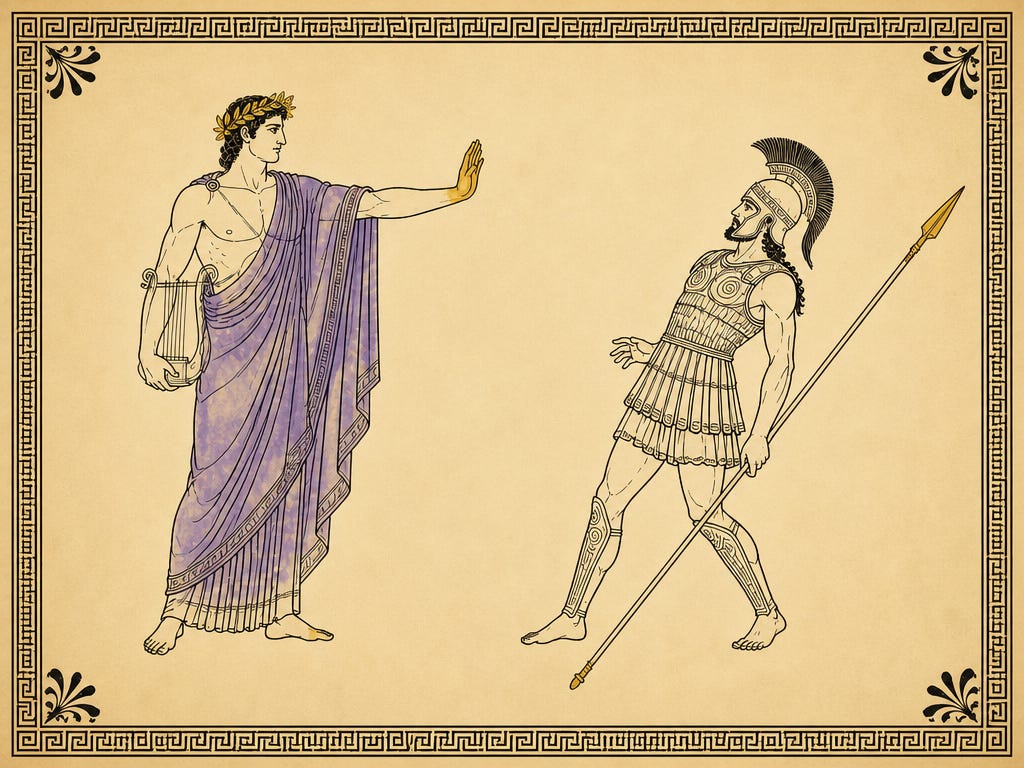
Think, son of Tydeus.
Know the difference between gods and men.
Step back.
And Diomedes does. He listens.
I sat there staring at this… paralyzed for a while.
Because I had been ready to publish. I had an unfinished theory on my desk and had basically decided that I was done waiting. Push it out. Let the world have it. Repair whatever remained afterward.
And then I dream a name I do not consciously know… look it up… and discover that one of the defining moments attached to that name is a man being stopped by Apollo on the fourth charge.
Enough.
Do not make the fourth charge.
Back up.
Ah. Okay then… Very funny!
It took me about a day to understand that the name was not arriving as praise.
It was a hand on my chest.
And to be clear about what happened: the dream did not do any physics for me. It did not hand me a derivation. It stopped me from doing bad physics, which is a different kind of gift and, I have come to think, the only kind the old gods actually give.
The draft stayed in the folder.
I was ready to ship an unfinished theory.
A mythological Greek I had somehow missed in school talked me out of it.
And looking back, I think the important word was not simply no.
It was not yet.
The Greeks had another idea for this: kairos. Not clock time. The right time. The moment when something is ripe for the action you are about to take.
That is different from waiting because you are afraid.
Sometimes waiting is part of the work.
The Fennel Stalk
This does not mean the Promethean problem went away.
It got worse!!!
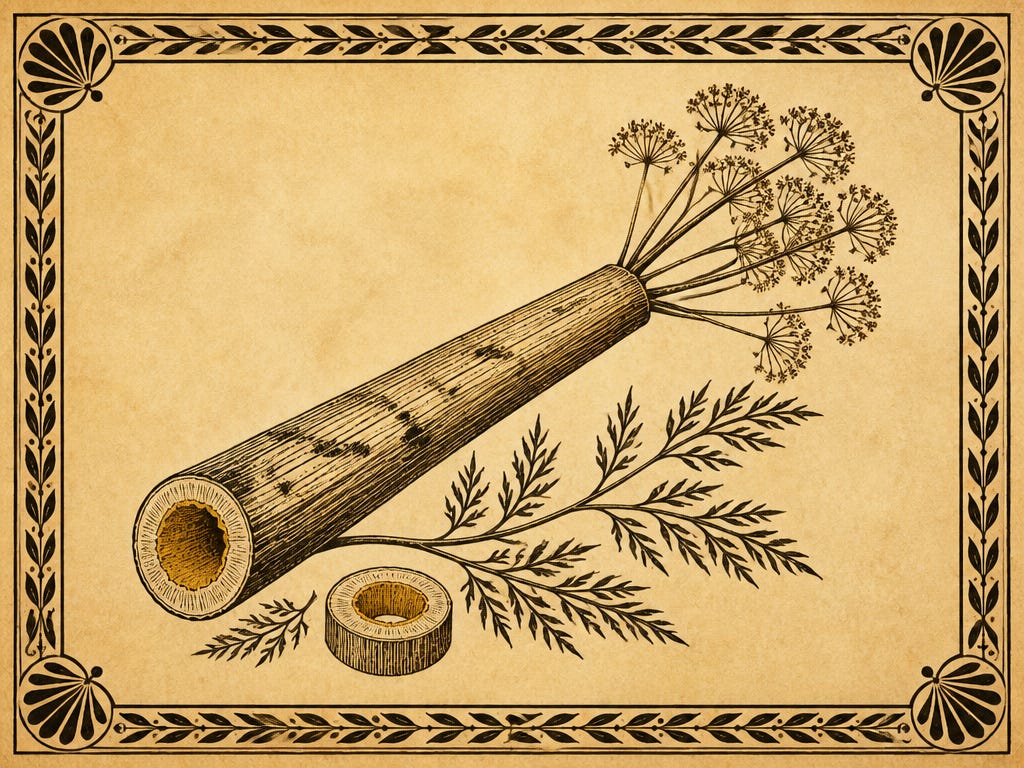
Prometheus believed fire belonged with humanity. Zeus did not. So Prometheus hid the flame inside a fennel stalk and carried it down concealed.
I understand that image now in a way I did not before, because my current posture is uncomfortable. The results are public. A great deal of the work can be tested. I talk openly about what the framework appears able to do.
But the deepest mechanism is still protected.
Not because mystery is a business strategy. Because once something is public, it is public. And deep tech is not a primary-school show-and-tell where the first person who asks nicely receives the contents of the safe. If you have built something genuinely new, particularly something with commercial value, you protect the mechanism while you establish the evidence around it. The real question is whether the thing works, and that part can be tested without giving away the machine.
So yes… I am carrying fire inside the stalk.
You can see what it does.
You can test the heat.
You do not necessarily get the recipe for the fire.
Apollo calls this sequencing.
Prometheus still finds it uncomfortable.
Depending on the day… so do I.
I should say that Prometheus is only one of the fires in this house. His, is the fire you want to put in other people’s hands. There is another one, the kind that keeps me at the desk at one in the morning when nothing is working, and that one has a different name and will get her own essay…
Because the tension is not merely commercial. There are moments when I look at some internal result and think: if this survives, how long am I entitled to keep this in a folder?
That is not a rhetorical question for me. It genuinely bothers me.
And then another part of me answers:
Until you know what the hell you are talking about.
Also fair.
I have come to think of this less as secrecy than custody. Stewardship, maybe. The thing does not entirely belong to me if it is true. But that does not mean I discharge my responsibility to it by throwing it into the street unfinished.
There is a strange period in the life of an idea when you may be its only custodian and yet already feel that you are holding it on behalf of people who do not know it exists.
I do not have a clean philosophy for that.
I am making one up as I go.
An investor once passed because he could not inspect the deepest mechanism. That part I understood. What was stranger was that I offered the obvious alternative… test the thing on a problem of your choosing… and that was declined too.
There I become less generous.
You do not need to know the metallurgy of the stove before checking whether the water boils.
There is legitimate skepticism about a protected mechanism. Then there is not wanting to look at the result. Those are different things.
Prometheus wants to split the stalk open and end the argument.
Apollo keeps saying:
No.
Let the results speak first.
Prometheus Has a Brother
Everybody remembers Prometheus.
Almost nobody remembers his brother.
Which is unfortunate, because Epimetheus may be the more dangerous one.
Prometheus means forethought. Epimetheus means afterthought. He is the brother who understands what has happened once it is already too late.
And that is the temptation that frightens me much more than being wrong.
Because the easiest possible version of Flux Theory would be Epimethean. Find an interesting number, then explain it. Find another, explain that too. Eventually you have a whole universe in which every answer has a beautiful story attached to it. Wonderful. Completely worthless.
Humans are absurdly good at this. Give me a result and enough coffee and I can probably construct a mechanism for it by lunchtime. I am an illustrator, a programmer and a composer. Pattern is what my brain does for sport. Which means the same mind that may be unusually good at finding a pattern is also unusually good at inventing one.
That is worth being afraid of.
Scientific method, at least the way I have come to practice it, is partly an artificial restraint placed on one of our greatest cognitive talents. We make meaning. We tell stories. We connect the dots. Marvelous. Now freeze the test before you see where the dots land.
The Eureka moments make this more dangerous, not less. When something suddenly closes, there is a tremendous emotional temptation to believe the closure means more than it does. You have been pushing against a wall for three days. Then the wall opens. Of course you want to run through it. Apollo is the irritating fellow standing in the doorway asking whether you have checked what is on the other side.
So I built fences against myself. If a mechanism is discovered after the numerical target, it has to earn its way back into standing. The test conditions get frozen before the next run. Scripts precede the documents that rely on them. Failed routes stay failed unless some genuinely new physical reason reopens them. And when one machine says yes, I make another machine rerun it before I let myself become emotionally attached.
This can become comical. There have been days when I feel less like the author of Flux Theory than its probation officer.
But the method exists so that forethought stays forethought.
Otherwise Prometheus quietly becomes Epimetheus while nobody is looking.
The Rock
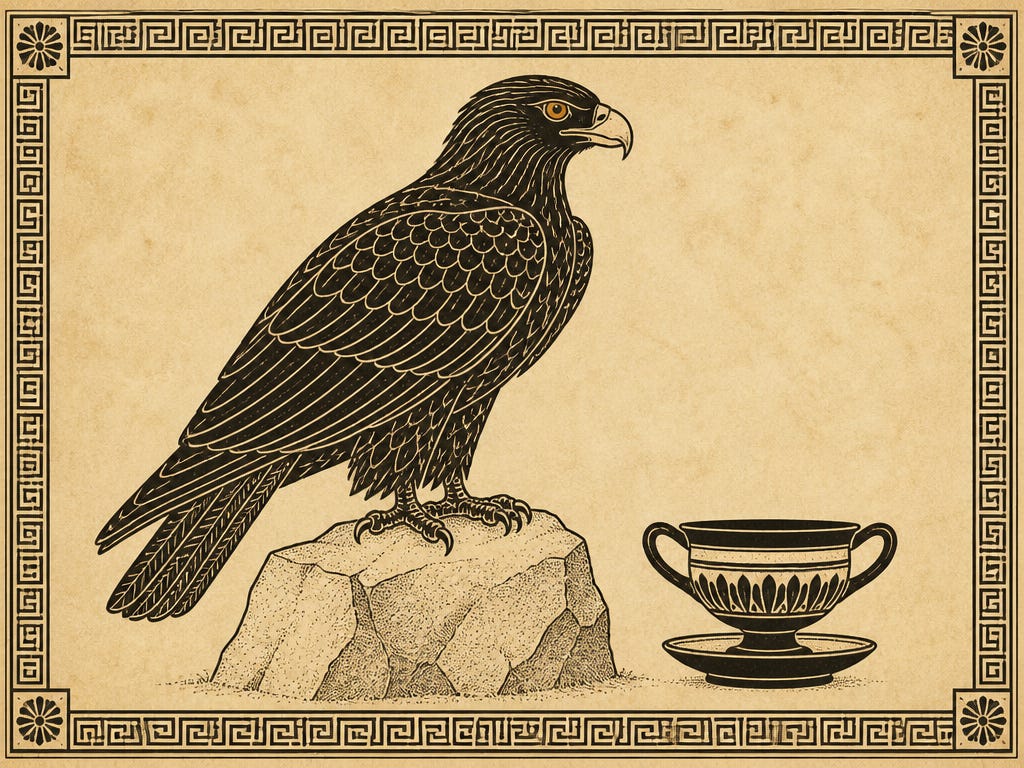
Then there is the punishment. Prometheus is chained to a rock. Every day an eagle comes down and eats his liver. Every night the liver grows back.
Morning comes… Eagle again!
This is, more or less, theoretical research.
You wake up with a derivation you loved yesterday.
You attack it. You find the weak assumption. You cut that away. You rerun. Something else breaks…
You repair the architecture without changing the target.
The next morning you try to kill it again.
Sometimes the eagle arrives after weeks of work.
That one REALLY hurts.
You discover that the beautiful closure depended on one assumption that nobody had actually earned.
Delete.
A whole branch goes dark.
There are moments when I sit here staring at the screen thinking that I am profoundly unqualified for what I have somehow assigned myself to do.
Which, in a very literal sense, is true.
I did not train for this.
There are days when I am looking at some hideous piece of mathematical physics and have the sudden, clarifying thought:
Robbè… you learned what that symbol meant on Tuesday.
Excellent! Very reassuring.
Apparently at some point I accidentally enrolled myself in the world’s least accredited graduate program. There is no supervisor, no diploma, the tuition is paid entirely in sleep deprivation, and the final examination is administered every morning by a large bird of prey.
Career planning has never been my strongest skill I guess…
And unfortunately, once I finally learn the new piece of physics, Flux does not reward me by allowing a new constant.
Same little box of tools.
Vediamo, Robbè. (Let’s see, Robbè.)
Do it again!
So I am learning pieces of mathematics and physics because the work keeps demanding them from me. Sometimes the gap between what I need to understand and what I currently understand feels absurd. Talk about impostor syndrome!
So I learn the thing. Not all of calculus (I am not Mr. Spock). Not all of whatever new monster has crawled out of the derivation this week.
Just enough to ask the next honest question (thank you YouTube!). Then enough to discover that the next honest question is worse.
Ma dai.
Back to the rock.
And there is something strangely useful about being forced to learn this way. I cannot rely very much on familiarity or professional muscle memory because I do not have them. I have to keep asking the stupid question.
What does this actually mean?
Why is that term there?
What physical thing is this symbol supposed to represent?
Sometimes the stupid question turns out to be stupid. Quite often, actually. But occasionally it is the question everyone stopped asking because it is not allowed around respectable mainstream physicists…
Those are interesting days. I have been on this rock for a while. Ouch!
The difference is that in my version of the myth, I hired the eagle.
That may be the most Apollonian thing I have done.
The adversarial audit is not an enemy arriving from outside. It is part of the workflow. As a professional coder for 25+ years, this is the way things are done. If the test pass, you commit and push the changes to the repo. So... every serious claim gets an eagle. Some survive. Some get their liver eaten and never grow it back. Some become weaker claims. Some become better claims.
And every once in a while something survives everything I know how to throw at it.
Those are the moments that keep me here. Not because survival proves the thing true. But because after enough mornings on the rock, you begin to notice which pieces keep growing back.
That is the job.
The eagle comes at nine.
I bring it coffee.
Nobody Gets Off the Rock Alone
There is one more part of the Prometheus story that matters.
He does not free himself.
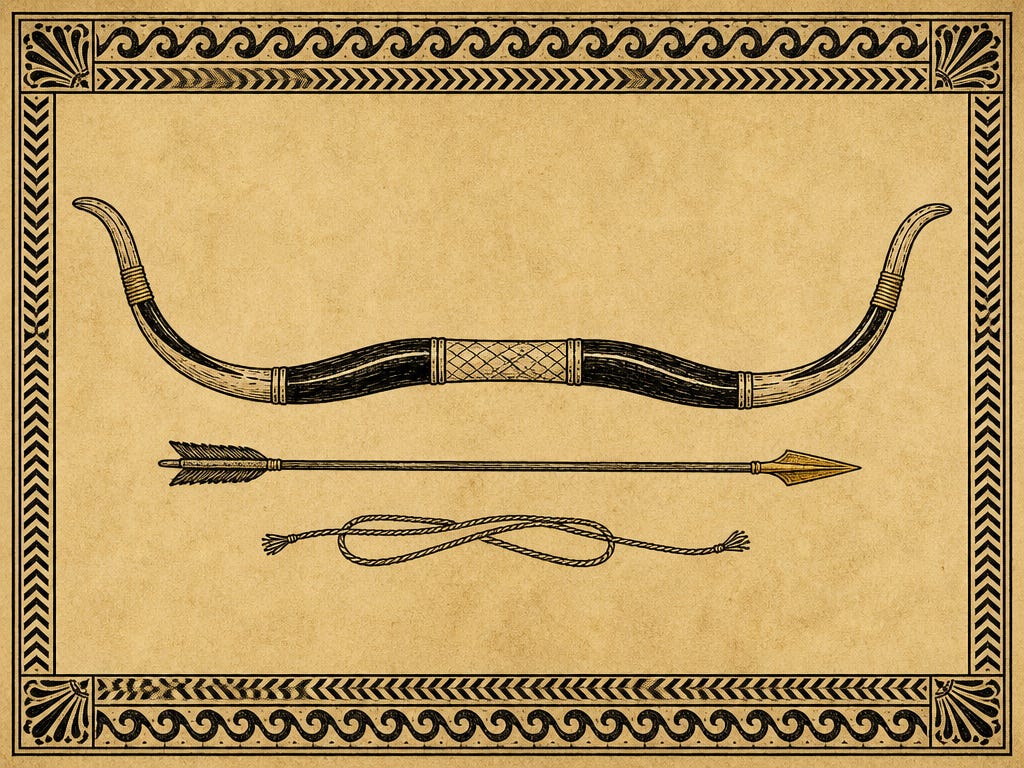
Eventually Heracles comes along and shoots the eagle.
An outsider.
His bow.
His arrow.
Prometheus can survive the punishment. He can understand the fire better than anyone alive. But he cannot produce his own release.
Neither can I.
At some point the work has to encounter a verdict that did not originate with me. Someone else chooses the target. I do not know the answer. The prediction gets made. Then reality gets to speak.
That is enough.
I have written elsewhere about blind testing and why it matters. I do not need to make the whole case again here.
There is a deeper reason anyway.
Discovery and verification are asymmetric things. A person can discover something alone. But there are forms of knowledge that cannot become independent while remaining entirely inside the mind that produced them.
No amount of self-skepticism can make me not-me.
I can attack my assumptions. I can invite the eagle every morning. What I cannot manufacture is the epistemic position of somebody who did not originate the idea and owes it nothing.
That is what Heracles represents for me.
Not approval.
Independence.
Nobody on the rock frees himself.
Someone else has to pull the bow.
And this is why the restraint matters more now than it did when I nearly published that first incomplete draft.
Back then, waiting felt like fear.
It does not anymore.
It feels heavier than that.
There are moments when I worry that I am waiting too long. There are other moments when I worry that I have already said too much. Both fears come from the same place.
What if this matters?
If it does not, fine. Eventually the eagle will find the fatal piece and we can all go home.
But if it does…
Then the obligation is not merely to publish.
The obligation is to get it right.
And perhaps this is the part of Apollo I understand best now. Measure does not remove responsibility. Measure tells you how much responsibility you have actually earned the right to act on. Diomedes steps back from Apollo, and he is not diminished by it. He survives. Later traditions send him west, eventually into Italy, where the warrior becomes a founder of cities.
I rather like that ending. The hero who knows when to charge is useful. The hero who knows when to stop gets to build something afterward.
So the two gods are still here.
Prometheus wants the fire in everybody’s hands tonight. Apollo is sitting beside him with a ruler. I still do not particularly enjoy being between them. But I understand the arrangement now. Forethought without measure becomes arrogance. Measure without fire becomes sterility.
The work needs both.
Because fire by itself is private revelation. It may be brilliant. It may even be true. But if nobody else can test it, inherit it, reproduce it, then it remains mine. Measure is what allows the thing to leave my hands without requiring the next person to believe me. The test of whether I have done my job is whether a stranger could check it with my name removed.
That, finally, may be the reconciliation.
Prometheus gives humanity the fire.
Apollo makes it transmissible.
And the old gods, in my experience, are rarely kind enough to hand you an answer.
They give you something much more irritating.
A discipline.
Then they wait to see whether you use it.
I asked for fire… yes, I did.
Apollo gave me a ruler and told me to wait.
Porca miseria! (Damn!)
I think that may have been the gift…
Roberto Campus (born 1974, Sardinia) is a coder, composer, visual artist, and entrepreneur who’s spent 35 years obsessing over the mysteries of the universe. Grew up in Rome with stubborn questions and an insatiable curiosity. He’s either onto something profound or needs a better hobby. Possibly both. Time will tell.